

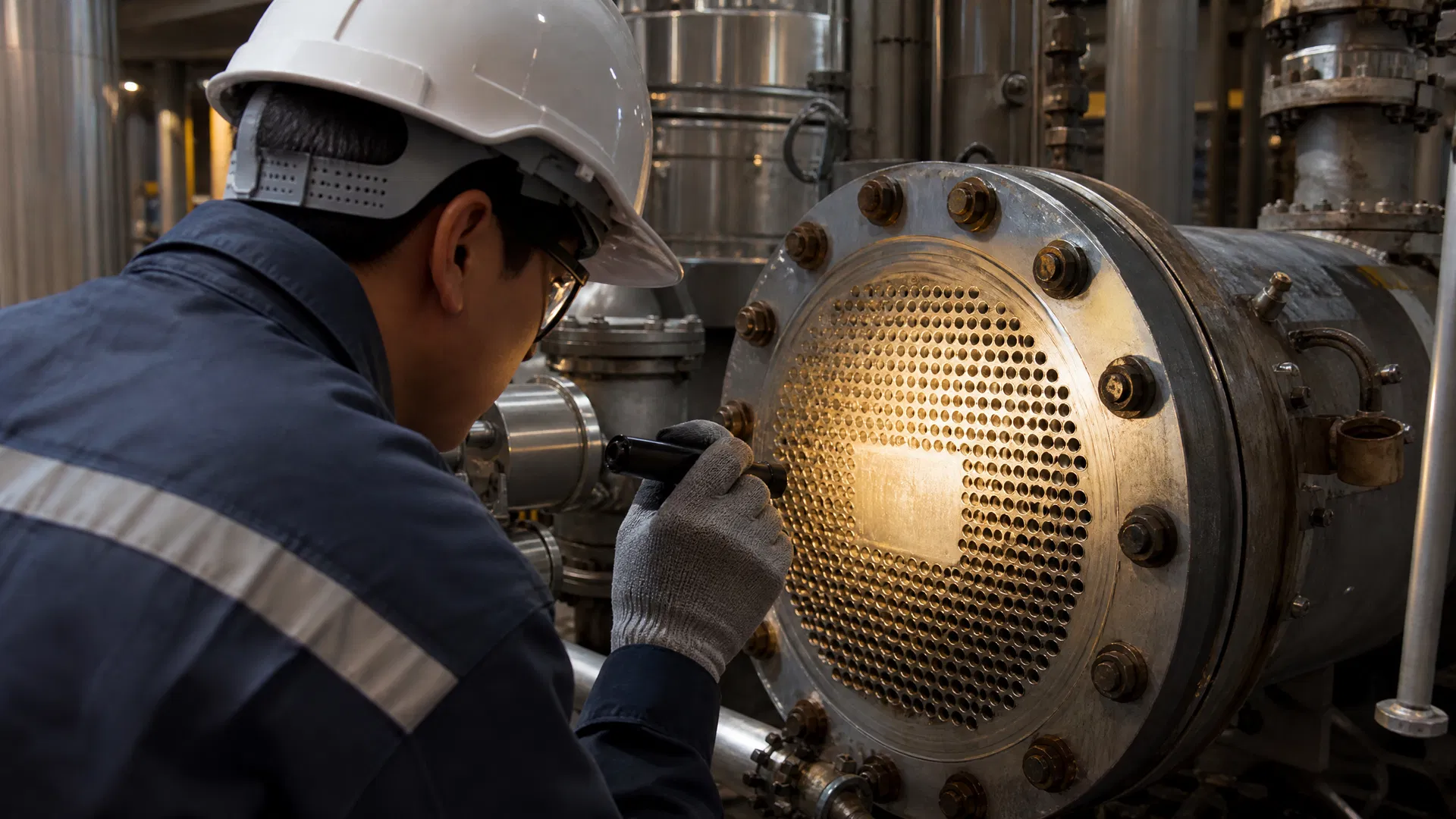
Before selling your used heat exchanger to us, you should inspect and document the unit's condition so we can provide the most accurate cash offer possible. The key items to check are the nameplate data, shell and tube wall thickness, flange face condition, nozzle integrity, and overall corrosion state. You do not need to perform expensive third-party inspections — clear photos and basic measurements are enough for us to quote you within 24 hours.
Surplus Heat Exchangers buys used and surplus heat exchangers nationwide — 100% upfront, with free rigging and freight, in any condition. Send a photo of the nameplate to 951-403-5738 for a same-day cash offer.
Why a Pre-Sale Inspection Helps You Get a Better Offer
When you contact Surplus Heat Exchangers to sell your unit, we base our cash offer on the information you provide. The more complete and accurate that information is, the stronger the offer we can make on the first pass. Vague descriptions like "old heat exchanger, looks okay" force us to assume worst-case condition, which means a lower initial quote. Conversely, sellers who provide clear photos, nameplate data, and basic condition notes almost always receive higher offers because we can see exactly what we are buying.
This checklist is not about spending money on inspectors or NDE contractors. We buy heat exchangers in any condition — working, idle, damaged, or destined for scrap. The purpose of this guide is to help you quickly gather the information that allows us to pay you the maximum amount for your specific unit. Think of it as a 30-minute walkdown that can add thousands of dollars to your offer.
We have purchased thousands of heat exchangers from refineries, chemical plants, power stations, food processing facilities, and HVAC mechanical rooms across all 50 states. The items on this checklist reflect what our valuation team actually looks at when pricing a unit. If you can address even half of these points, you will be ahead of 90% of sellers.
The Nameplate: Your Most Valuable 60 Seconds
The single most important thing you can do before calling us is photograph the nameplate. This small metal tag, typically riveted to the shell or channel cover, contains the manufacturer's original specifications and is worth more to our valuation process than almost anything else you can provide.
A standard ASME nameplate includes the manufacturer name, serial number, year built, National Board number, maximum allowable working pressure (MAWP), design temperature, and materials of construction for both shell and tube sides. TEMA-class exchangers also show the TEMA type designation (e.g., BEM, AES, AEP) which tells us the exact mechanical configuration.
If the nameplate is corroded, painted over, or partially illegible, photograph it anyway and try to read what you can. Even a partial serial number or manufacturer name allows us to research the original specifications. If the nameplate is completely missing, the unit is still sellable — we buy heat exchangers without nameplates regularly — but having it dramatically speeds up our valuation and typically results in a higher offer because we can verify the materials and ratings with certainty.
Take at least two photos of the nameplate: one straight-on with good lighting, and one at an angle that catches the stamped characters in relief. A flashlight held at a low angle across the surface often reveals stamped text that is invisible in direct light.
Shell Condition: What to Look For
Walk around the exterior of the shell and note the overall condition. We are looking for three things: general corrosion state, any visible damage, and the condition of external attachments.
For general corrosion, note whether the shell has surface rust (cosmetic, does not affect value significantly), deep pitting (may affect value depending on remaining wall thickness), or is structurally compromised (holes, severe thinning). Surface rust from outdoor storage is extremely common and does not concern us — we buy units with surface rust every day. What matters is whether the base metal underneath is still sound.
For visible damage, look for dents, gouges, or impact marks on the shell. Note any areas where the shell appears deformed, bulged, or out-of-round. Check the saddle supports for cracking or deformation. Look at the lifting lugs — are they intact, or have they been cut off? None of these issues necessarily make a unit unsellable, but documenting them helps us provide an accurate offer.
For external attachments, note the condition of insulation (if present), any external piping still connected, instrumentation connections, and the overall state of the paint or coating system. If the unit has been sitting outdoors, note approximately how long it has been exposed to weather.
If you have access to ultrasonic thickness (UT) readings, these are extremely valuable to our valuation. Even a few spot readings on the shell at the 6 o'clock position (where corrosion is typically worst) give us confidence in the remaining wall thickness. However, do not hire a contractor specifically for this — it is not necessary for us to make an offer.
Tube Bundle Condition
If the tube bundle is accessible (pulled, or visible through an open channel), document its condition. If the bundle is installed and the channel covers are bolted on, do not open the unit — just tell us it is assembled and we will factor that into our assessment.
For an exposed tube bundle, note the following: Are the tube ends visible at the tubesheet? What is their condition — clean, scaled, plugged, or corroded? How many tubes appear to be plugged (look for tapered plugs or welded caps in the tube holes)? Is the tubesheet face in good condition, or is it severely eroded between the tube holes (ligament erosion)?
Check the baffles if visible. Are they intact, or have they eroded into thin crescents? Baffle erosion is common in high-velocity or abrasive services but does not necessarily kill a deal — it depends on severity. Note whether the tubes show signs of vibration damage (flattened or worn spots where they pass through baffle holes).
For the tube material, the nameplate should specify this, but if you can visually identify the tubes (copper is obvious by color; stainless is bright and non-magnetic; titanium is gray and very light; carbon steel is magnetic and dark), note what you see. Tube material is one of the biggest value drivers — a bundle of titanium tubes is worth dramatically more than carbon steel.
Nozzles, Flanges, and Connection Points
Inspect all nozzles on the shell and channel sides. Note the flange rating (typically stamped on the flange — 150#, 300#, 600#, etc.), the size (e.g., 6", 8", 10"), and the facing type (raised face is most common; ring-type joint indicates high-pressure service and adds value).
Check the flange faces for damage. Are the gasket seating surfaces smooth and undamaged, or do they show scoring, gouging, or corrosion? Minor surface imperfections on flange faces are repairable and do not significantly affect value. Severe damage that has removed material from the gasket seating area is more concerning but still not necessarily a deal-breaker.
Note whether all nozzles have blind flanges or covers installed. Units that have been properly preserved with blind flanges on all openings are worth more because the internals have been protected from weather and contamination. Open nozzles that have been exposed to rain and debris for years suggest the internals may have deteriorated.
Count the nozzles and note their approximate sizes. This helps us identify the TEMA type even if the nameplate is missing. For example, a unit with four large nozzles on the shell side likely has a divided-flow or split-flow configuration, which tells us about the original service and helps with valuation.
Overall Dimensions and Weight
We need approximate dimensions to plan logistics and estimate value. Measure or estimate the following: overall length (tube end to tube end, including channels), shell outside diameter, and approximate weight. If you cannot weigh the unit, an estimate is fine — we can calculate approximate weight from the dimensions and materials.
For reference, a typical 20-foot shell-and-tube exchanger with a 24-inch shell diameter weighs approximately 8,000–12,000 pounds depending on materials and tube count. Larger units in the 30–48 inch diameter range can weigh 20,000–60,000 pounds or more. Knowing the approximate weight helps us plan rigging and freight, which we provide at no cost to you.
Note the orientation: is the unit horizontal on saddles, vertical on a skirt, or still installed in a pipe rack? Is it accessible by crane, or will it require disassembly of surrounding structures to extract? These logistics details do not affect the purchase price we offer, but they help us plan the removal efficiently.
Documentation You May Have
Beyond the nameplate, any of the following documents add value to your offer by giving us certainty about what we are purchasing:
- U-1 Data Report: The original ASME manufacturer's data report. This is the gold standard of documentation and can significantly increase your offer.
- General arrangement drawings: Show the internal configuration, tube layout, baffle spacing, and materials schedule.
- Inspection reports: API 510 inspection reports, UT thickness surveys, or eddy current tube inspection results.
- Maintenance records: Retubing history, repair records, or hydro test certificates.
- Material test reports (MTRs): Original mill certificates for tubes, shell, and tubesheet materials.
If you do not have any of these documents, that is perfectly fine. We buy heat exchangers without documentation every week. The nameplate alone gives us enough to make a competitive offer. But if you do have paperwork sitting in a filing cabinet somewhere, pulling it out before you call us is worth the effort.
Quick-Reference Inspection Checklist
| Item | What to check | How it affects your offer |
|---|---|---|
| Nameplate | Photo both straight-on and at angle; note all readable data | High impact — enables accurate valuation |
| Shell exterior | Surface rust vs deep pitting vs holes; dents or deformation | Moderate — cosmetic rust is fine, structural damage lowers value |
| Tube bundle | Tube end condition, plugged tube count, baffle erosion | High impact — tube material and condition drive value |
| Flanges/nozzles | Size, rating, face condition, blind flanges installed? | Moderate — indicates preservation quality |
| Dimensions | Length, diameter, estimated weight | Helps logistics planning (does not change price) |
| Tube material | Stainless, titanium, copper, carbon steel, exotic alloy? | Very high impact — alloy is the #1 value driver |
| Documentation | U-1 form, drawings, inspection reports, MTRs | High impact — adds certainty and increases offer |
| Storage condition | Indoor/outdoor, preserved/open, duration of storage | Moderate — well-preserved units command premium |
| Accessibility | Crane access, obstructions, installed vs ground-level | No price impact — we handle all rigging regardless |
What Happens After You Send Us This Information
Once you have completed this walkdown and gathered your photos and notes, the process of selling to us is simple. Send everything to us via text, email, or phone — whatever is easiest for you. Our valuation team reviews the information, typically within the same business day, and provides a firm cash offer.
If you accept the offer, we handle everything from that point forward: purchase agreement, payment (wired to your account before we pick up the unit), rigging, crane service, freight, and all logistics. You do not need to do anything except grant site access for our removal crew.
We buy heat exchangers in any condition, from pristine new-old-stock units still in factory packaging to severely corroded vessels that most buyers would reject. This checklist simply helps you get the highest possible offer by giving us the information we need to see the full value of your equipment rather than assuming worst-case.
Ready to sell? Call us at 951-403-5738 or send your photos and nameplate data to our secure online quote form. We provide free, no-obligation cash offers on any heat exchanger, anywhere in the United States. Get your cash offer now.