
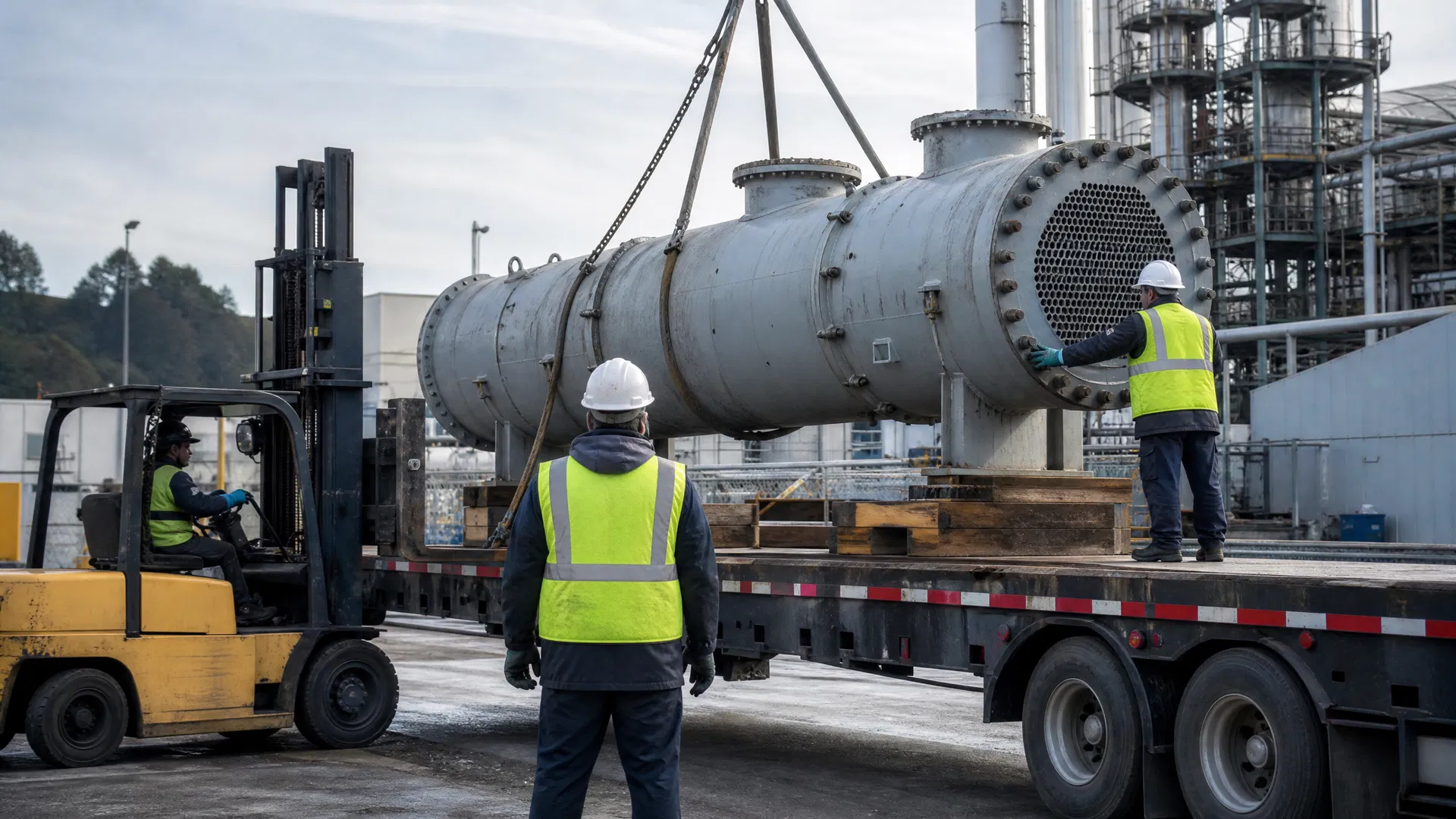
The resale value of your used heat exchanger is primarily driven by its material of construction, complete documentation, physical condition, and the inclusion of all original components. By providing clear photos, maintaining the unit properly before sale, and choosing a direct buyer who covers freight, you can maximize your return and secure a fast, upfront cash payment.
Surplus Heat Exchangers buys used and surplus heat exchangers nationwide — 100% upfront, with free rigging and freight, in any condition. Send a photo of the nameplate to 951-403-5738 for a same-day cash offer.
How does the material of construction impact the resale value of a heat exchanger?
The material composition of your heat exchanger is arguably the single most significant factor in determining its resale value on the secondary market. Industrial heat exchangers are designed to handle a wide variety of fluids, from benign cooling water to highly corrosive acids, and the metals used in their construction reflect these demanding applications. When evaluating a used unit, buyers look closely at both the shell and the tube or plate materials to determine its future utility and intrinsic value.
To understand the baseline value, it is helpful to look at current scrap metal prices, which serve as the absolute floor for your equipment's worth. For instance, carbon steel typically commands a scrap value of only a baseline commodity rate. Moving up the scale, 304 stainless steel ranges from only a baseline commodity rate, while 316 stainless steel fetches only a baseline commodity rate. Non-ferrous and exotic metals push these baseline values even higher: copper sits at only a baseline commodity rate, admiralty brass at only a baseline commodity rate, cupro-nickel at only a baseline commodity rate, and titanium commands a premium at only a baseline commodity rate.
However, a functional heat exchanger is worth far more than its weight in scrap. In the used equipment market, a shell and tube heat exchanger typically resells for roughly a significant premium over scrap based on its heat-transfer surface area, heavily dependent on the materials, design pressure, and overall condition. Units constructed from high-grade alloys like Hastelloy, Inconel, or Titanium will always sit at the top end of this spectrum. Furthermore, equipment manufactured by industry-leading brands such as Alfa Laval, GEA, Tranter, Standard Xchange, ITT, SPX/APV, Kelvion, and SWEP generally retain their value better due to their proven reliability and the widespread availability of replacement parts.
Why is documentation critical when selling your used heat exchanger?
In the industrial equipment market, a heat exchanger without documentation is often treated as little more than scrap metal, regardless of its pristine physical condition. Documentation proves the unit's design specifications, pressure ratings, and manufacturing history, which are essential for the next user to safely and legally integrate the equipment into their process.
The most critical piece of documentation is the ASME U-1 Data Report. This document provides a comprehensive overview of the vessel's construction, including the exact materials used, the design pressures and temperatures, and the specific TEMA (Tubular Exchanger Manufacturers Association) designations, such as TEMA B (chemical process service), TEMA C (general commercial service), or TEMA R (refinery service). Without the U-1 form, a buyer cannot verify the pressure vessel's integrity, making it virtually impossible to resell for pressurized applications where safety is paramount.
In addition to the U-1 form, original manufacturer drawings, inspection reports, and maintenance logs significantly boost the unit's value. A clear, legible nameplate is also non-negotiable. The nameplate contains the National Board number, serial number, and design parameters. If the nameplate is missing or illegible, the value of the heat exchanger plummets. When you contact Surplus Heat Exchangers, providing a clear photo of the nameplate along with any available U-1 forms allows us to make the highest possible offer.
Does cleaning and maintaining the unit increase its market worth?
Absolutely. The physical condition of a heat exchanger directly impacts the amount of labor and capital a buyer must invest to prepare the unit for resale. When a heat exchanger is pulled from service, it often contains residual process fluids, scale, biological growth, or hydrocarbon deposits. If left uncleaned, these residues can cause accelerated corrosion, pitting, and degradation of the heat transfer surfaces, particularly in carbon steel and lower-grade stainless steel units.
Flushing the unit and neutralizing any corrosive chemicals immediately after decommissioning is a best practice that preserves the integrity of the tubes and shell. Furthermore, capping the nozzles with blind flanges or heavy-duty plastic covers is a simple yet highly effective way to protect the internal components from moisture, dirt, and nesting animals during storage. If the unit must be stored outdoors, covering it with a heavy-duty tarp and ensuring it is elevated off the ground on wooden skids will prevent external rust and weather damage.
A well-maintained unit signals to buyers that the equipment has been cared for throughout its lifecycle. It reduces the perceived risk of hidden internal damage, allowing buyers to offer a premium price. Even if your unit is heavily fouled or has been sitting outside for years, Surplus Heat Exchangers buys equipment in any condition, but presenting a clean, well-preserved unit will always yield a higher valuation.
How does the completeness of the heat exchanger affect the final offer?
When selling a used heat exchanger, completeness is key. A heat exchanger is a highly engineered system, and missing components can drastically reduce its value or render it entirely unusable. For shell and tube heat exchangers, buyers expect the shell, tube bundle, channel heads, bonnets, and all associated bolting to be intact. If a tube bundle has been pulled and the shell discarded, the value is significantly diminished, as finding a matching shell with the correct nozzle orientations is often cost-prohibitive.
For plate and frame heat exchangers, completeness means having the fixed and movable frame plates, the upper and lower carrying bars, the tightening bolts, and the full pack of corrugated plates. Missing tie rods or damaged frame plates can turn a valuable piece of process equipment into a pile of spare parts that are only good for scrap.
Here is a quick checklist of components that should be kept together to maximize your resale value:
- Shell and Tube Units: Shell, tube bundle, channel heads, bonnets, baffles, and original bolting.
- Plate and Frame Units: Fixed frame plate, movable pressure plate, carrying bars, tightening bolts, and the complete plate pack.
- Air-Cooled Units: Finned tube bundles, fan blades, motors, plenums, and structural supports.
- Accessories: Any attached instrumentation, valves, sight glasses, or custom mounting brackets.
Keeping all original components together ensures the unit can be refurbished and resold as a complete system, which commands a much higher price in the secondary market compared to selling individual parts.
What role do high-quality photos play in getting the best price?
In the modern surplus equipment market, the initial evaluation is almost always conducted remotely. High-quality, comprehensive photographs are your best tool for conveying the true condition and value of your heat exchanger to potential buyers. Poorly lit, blurry, or incomplete photos force buyers to assume the worst-case scenario regarding the unit's condition, leading to lower, more conservative offers to mitigate their risk.
To get the best possible price, you should provide a thorough photographic inventory of the equipment. Start with a clear, close-up, and perfectly legible photo of the manufacturer's nameplate. This is the most important photo you will take, as it provides the critical data needed to evaluate the unit. Next, provide wide-angle shots of the entire unit from multiple sides to show its overall footprint and external condition.
For shell and tube heat exchangers, take close-up photos of the nozzles, flanges, and, if possible, the tube sheets and channel heads. For plate and frame units, photograph the plate pack from the side to show the condition of the gaskets and the compression of the plates. If there is any visible damage, such as dents, severe rust, or bent tubes, photograph it clearly. Transparency builds trust, and a buyer who knows exactly what they are purchasing will always offer a more aggressive price. When you email your photos to our secure online quote form, our team can quickly assess the equipment and provide a firm cash offer.
Is timing important when deciding to sell surplus industrial equipment?
Timing plays a crucial role in maximizing the resale value of your surplus heat exchangers. The longer a piece of equipment sits idle, the more its value depreciates. This depreciation is driven by two main factors: physical degradation and market obsolescence.
Physically, idle equipment is highly susceptible to the elements. Even if a heat exchanger is drained and capped, prolonged exposure to fluctuating temperatures and humidity can lead to internal condensation, rust, and the deterioration of gaskets and seals. A unit that was in perfect working condition when decommissioned can become severely compromised after just a year of improper outdoor storage, turning a valuable asset into scrap metal.
From a market perspective, holding onto surplus equipment ties up valuable capital and takes up premium floor space in your facility. By selling your equipment immediately after it is taken out of service, you capture its highest possible market value and free up cash flow for other projects. Don't let your valuable assets turn into liabilities by letting them rust in a boneyard. Fast action ensures you get the best return on your initial investment and eliminates ongoing storage costs.
How does choosing the right buyer maximize your net return?
The final, and perhaps most important, factor in maximizing your resale value is choosing the right buyer. When selling surplus industrial equipment, you generally have three options: selling to an end-user, selling through a broker or auctioneer, or selling to a direct stocking dealer.
Selling directly to an end-user might seem like the best way to get top dollar, but it is incredibly time-consuming. You must market the equipment, field inquiries, negotiate terms, and often wait months or years for the right buyer to come along. Selling through an auction or broker involves hefty commissions, listing fees, and the uncertainty of what the final hammer price will be, not to mention the hassle of moving the equipment to an auction site.
Selling to a direct buyer like Surplus Heat Exchangers is the most efficient and profitable route. We eliminate the middleman and the waiting game. Here is a comparison of how different selling methods impact your bottom line:
| Selling Method | Payment Speed | Freight & Rigging Costs | Certainty of Sale | Net Return to Seller |
|---|---|---|---|---|
| Direct to End-User | Months to Years | Usually paid by buyer, but requires negotiation | Low (depends on finding a specific buyer) | Variable (high gross, but high holding costs) |
| Auction / Broker | 30 to 90 Days | Seller often pays to move equipment to auction site | Medium (subject to market demand on auction day) | Low to Medium (reduced by 15-30% commissions) |
| Surplus Heat Exchangers | Immediate (100% Upfront) | 100% Covered by Buyer | High (Firm cash offers) | High (No fees, no freight costs, immediate cash) |
At Surplus Heat Exchangers, we make the process seamless. We buy used and surplus heat exchangers nationwide, in any condition. We pay 100% upfront before the equipment ever leaves your facility, and we handle all the logistics, including rigging and freight. This means the offer we make is the exact amount of cash you keep. If you have surplus equipment taking up space, call us today at 951-403-5738 or email your photos and nameplate data to our secure online quote form for a fast, no-obligation offer.