
A heat exchanger nameplate contains critical specifications like the manufacturer, surface area, materials of construction, and design pressures, which directly determine its resale or scrap value. By locating and reading these fields, you can accurately identify your equipment's capabilities and secure the highest possible cash offer from industrial buyers.
Surplus Heat Exchangers buys used and surplus heat exchangers nationwide — 100% upfront, with free rigging and freight, in any condition. Send a photo of the nameplate to 951-403-5738 for a same-day cash offer.
What is a heat exchanger nameplate and where is it located?
When selling surplus industrial equipment, accurate information is your best asset. For heat exchangers, all vital information is stamped onto a small metal tag known as the nameplate. Think of it as the birth certificate of your equipment. It tells buyers exactly what the unit was designed to do and how it was built.
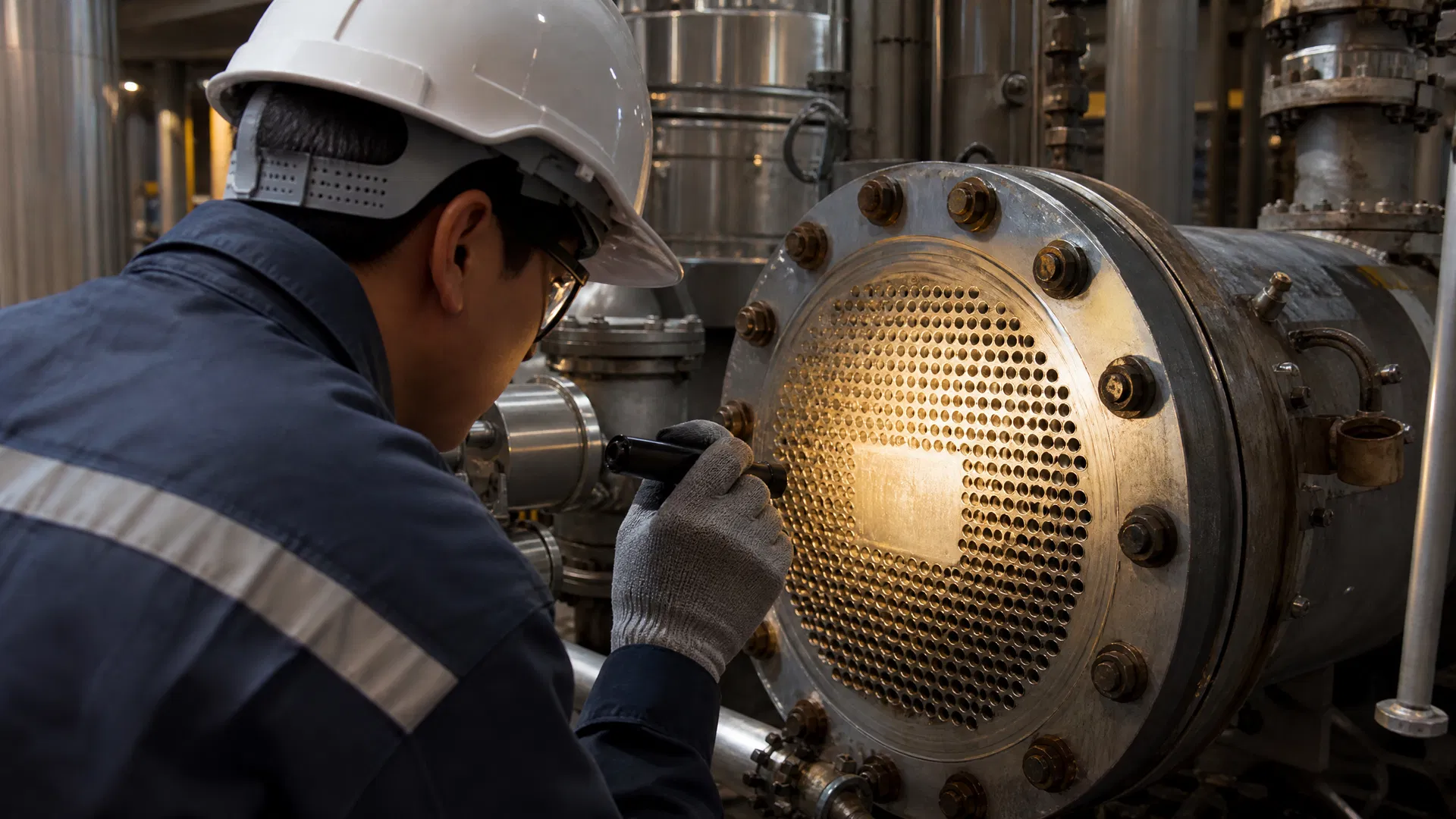
Typically made of stainless steel or aluminum, the nameplate is permanently attached to the unit. On shell and tube heat exchangers, you will usually find it riveted to the outer shell, channel head, or main support saddle. On plate and frame heat exchangers, it is almost always attached to the fixed frame plate near the tie rod bolts.
If your equipment has been in service for decades, the nameplate might be covered in paint or grime. Carefully clean the tag with a wire brush or solvent so the stamped numbers become legible. A clear nameplate is the fastest way to get an accurate valuation. Even if the unit is destined for scrap, the nameplate confirms the materials, ensuring you get paid the correct alloy rate.
Which manufacturers and brands add the most value?
The first thing any buyer looks for on a nameplate is the manufacturer. Brand reputation matters immensely in the secondary market. Buyers prefer established brands because they guarantee engineering quality and ensure that replacement parts and gaskets are readily available.
Look for the"MFG" or"Manufacturer" field. Sought-after brands that command premium resale prices include:
- Alfa Laval: A global leader, especially highly valued for their plate and frame exchangers.
- Standard Xchange (formerly ITT Standard): Extremely common and highly desirable for shell and tube applications.
- GEA and Kelvion: Known for robust engineering in both plate and shell/tube designs.
- Tranter and SWEP: Highly sought after for compact brazed and gasketed plate exchangers.
- SPX / APV: Premium brands in the food, beverage, and sanitary processing industries.
If your heat exchanger was built by a top-tier manufacturer, its resale value is inherently higher. Facilities often want an exact drop-in replacement to avoid re-piping, making specific brands highly liquid assets on the used market.
How does the surface area (sq ft) determine the resale price?
The most direct metric of a heat exchanger's capacity and value is its surface area. This represents the total physical area available for heat transfer. On the nameplate, this is typically abbreviated as"Surf. Area,""Area," or"Sq. Ft."
Surface area is a primary pricing factor. For shell and tube heat exchangers, resale value generally ranges from a significant premium over scrap value, heavily dependent on materials, pressure ratings, and the condition of the tube bundle.
A 500-square-foot carbon steel unit falls on the lower end, while a titanium unit commands the top of the market. Larger surface areas equate to higher overall values, though the price-per-square-foot often decreases slightly for massive units over 5,000 sq ft due to specialized logistics. Knowing your exact square footage allows buyers like Surplus Heat Exchangers to calculate a precise cash offer instantly.
What do MAWP and design temperature tell buyers about your equipment?
Safety limits are strictly defined by two fields on the nameplate: MAWP and Design Temperature.
MAWP (Maximum Allowable Working Pressure) indicates the highest pressure the vessel can safely handle. Because heat exchangers have two fluid paths, you will usually see two MAWP ratings: one for the"Shell Side" and one for the"Tube Side".
Design Temperature is the maximum temperature the unit is engineered to withstand.
Higher pressure and temperature ratings require thicker metal and stronger welds. A unit rated for 150 PSI is standard, but one rated for 600 PSI or 1,200 PSI is heavy-duty. High-pressure units are highly prized in the petrochemical industry. If your nameplate shows high MAWP numbers, your unit is worth significantly more in both resale value and raw scrap weight due to the thicker steel.
How do materials of construction impact scrap and resale values?
Materials are the ultimate wildcard in determining value. Industrial processes handle corrosive fluids, requiring expensive alloys. The nameplate usually lists materials for the shell, tubes, tubesheets, and heads separately. Look for abbreviations like"CS" (Carbon Steel),"SS" (Stainless Steel),"CU" (Copper), or grades like 304, 316, or Titanium.
When you sell to Surplus Heat Exchangers, we evaluate the unit for both scrap metal yield and secondary market resale potential, guaranteeing the highest possible valuation based on your nameplate's metallurgy.
What is a TEMA type and why does it matter for shell and tube units?
On a shell and tube heat exchanger, you will likely see a three-letter code labeled"TEMA Type." TEMA stands for the Tubular Exchanger Manufacturers Association, and their system describes the exact physical configuration.
- First Letter (Front Head): Describes the stationary head type (e.g., A for a removable channel cover, B for a bonnet).
- Second Letter (Shell): Describes the shell flow pattern (e.g., E for a one-pass shell, K for a kettle reboiler).
- Third Letter (Rear Head): Describes the rear head design (e.g., L for a fixed tubesheet, U for a U-tube bundle, T for a pullable floating head).
Common TEMA types include BEM, AEL, NEN, and BEU. The TEMA type heavily influences resale value because it dictates how easily the unit can be cleaned. A"U-tube" design (like BEU) allows the entire tube bundle to be pulled out for inspection, making it highly desirable. Conversely, a fixed tubesheet design (like BEM) cannot be easily mechanically cleaned on the shell side, slightly limiting its secondary market appeal.
What is a National Board (NB) number and why is it important?
In the United States, pressure vessels are strictly regulated. If your heat exchanger operates at high pressures, it will likely have a National Board (NB) number stamped on the nameplate, often accompanied by a"U" stamp indicating ASME certification.
The NB number is a unique registration code tied to the National Board of Boiler and Pressure Vessel Inspectors. This number allows buyers to request the original U-1A Manufacturer's Data Report.
If your nameplate is heavily corroded, the NB number acts as a backup. Buyers can retrieve the original engineering documents detailing the exact surface area, materials, and pressure ratings. This eliminates guesswork. When buyers have absolute certainty, their financial risk drops, allowing them to offer significantly more money. Always make sure the NB number is visible when taking photos.
How can you sell your used heat exchanger for top dollar today?
Now that you know how to read your heat exchanger nameplate, you have the information needed to turn idle equipment into working capital. Whether your unit is a pristine Alfa Laval plate exchanger or a retired carbon steel shell and tube unit destined for scrap, Surplus Heat Exchangers is ready to buy it.
We are a nationwide buyer specializing in surplus heat exchangers. We make the selling process completely frictionless for plant managers, contractors, and demolition teams. When you sell to us, you get:
- 100% Upfront Payment: We pay you in full before the equipment leaves your facility. No consignments, no waiting.
- Free Freight and Rigging: We handle all the heavy lifting. Our logistics team coordinates the cranes, flatbeds, and permits required to remove the equipment safely.
- Any Condition Accepted: We buy units in perfect working order for resale, and we buy end-of-life units for their scrap alloy value.
Don't let your valuable equipment rust in a boneyard. Take a clear photo of the entire unit and a close-up of the nameplate. Call us today at 951-403-5738 or email your photos to our secure online quote form. We will review your nameplate data and provide a fast cash offer so you can clear up space and boost your bottom line.