

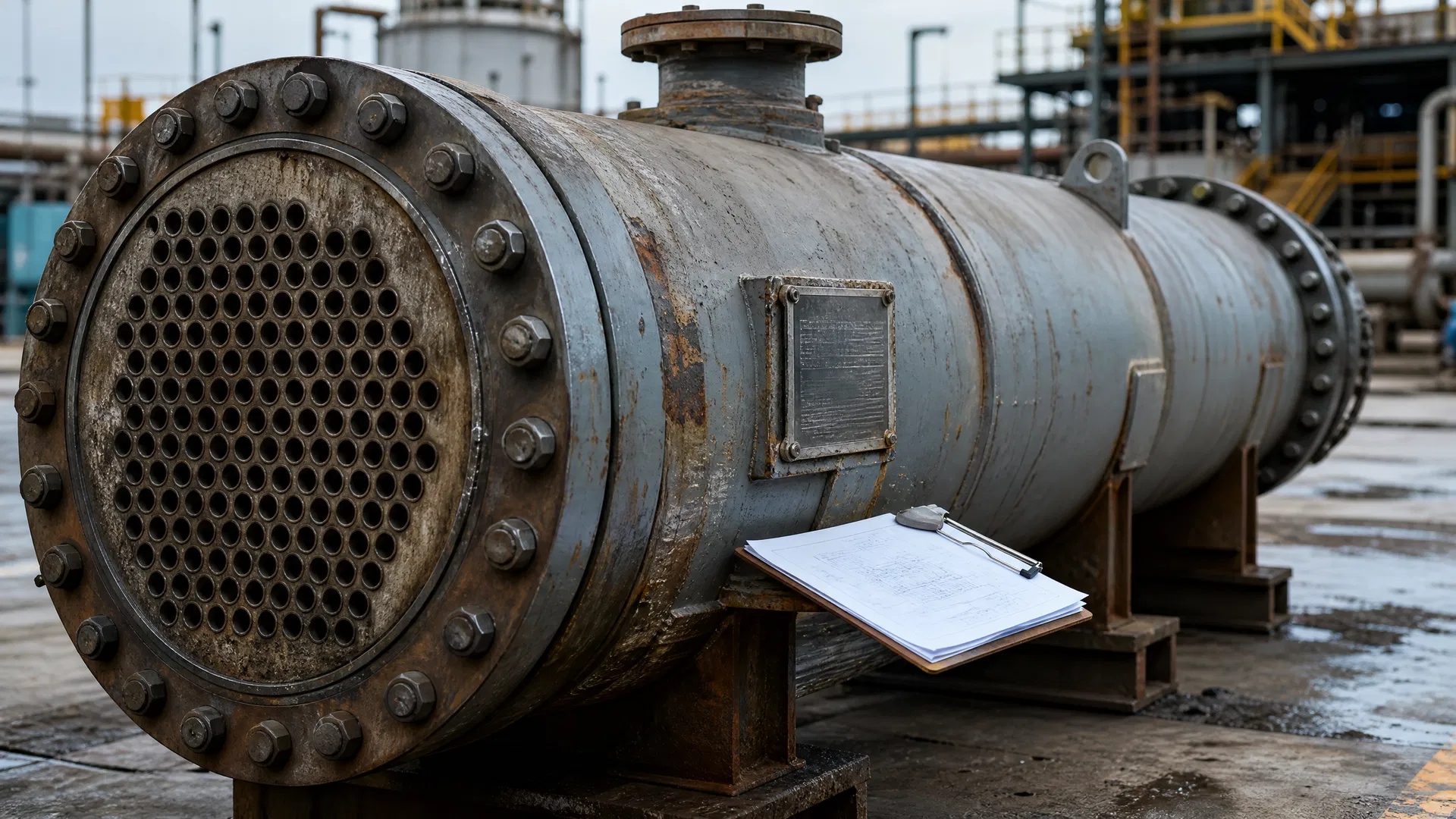
To estimate your heat exchanger's value, you must evaluate its surface area, materials of construction, current condition, and brand. While scrap values range from only a baseline commodity rate for carbon steel up to only a baseline commodity rate for titanium, functional shell and tube units can resell for a significant premium over scrap value on the surplus market. The fastest way to get an exact cash offer is to send the nameplate data and photos to a specialized buyer who can assess its reuse potential versus its raw material worth.
Surplus Heat Exchangers buys used and surplus heat exchangers nationwide — 100% upfront, with free rigging and freight, in any condition. Send a photo of the nameplate to 951-403-5738 for a same-day cash offer.
How much is a used heat exchanger worth on the surplus market?
When plant managers, demolition contractors, or procurement specialists look to liquidate surplus industrial equipment, the first question is always about the bottom line. The value of a used heat exchanger on the surplus market varies wildly based on whether it is destined for reuse or the scrap yard. For units that are in good working condition and can be refurbished, the resale value is significantly higher than the raw material weight. For example, a functional shell and tube heat exchanger typically commands between a significant premium over scrap based on its heat-transfer surface area, depending heavily on the metallurgy and design pressure.
If the unit is damaged beyond repair, heavily fouled, or obsolete, its value defaults to the current scrap metal commodity prices. However, many sellers make the mistake of assuming their idle equipment is only worth scrap weight. By working with a specialized buyer like Surplus Heat Exchangers, you can often secure a much higher payout because we evaluate the unit for its potential second life in another facility. Whether you have a massive TEMA-type shell and tube unit from a petrochemical plant or a compact brazed plate exchanger from an HVAC system, understanding the baseline metrics of valuation is crucial before you make a call.
What factors determine the resale value of a heat exchanger?
Several critical variables come into play when an equipment buyer calculates an offer for your surplus heat exchanger. The most significant factor is the material of construction. Exotic alloys and high-grade stainless steels inherently hold more value than standard carbon steel due to their corrosion resistance and high initial manufacturing costs.
The second major factor is the total heat transfer surface area, usually measured in square feet. Larger units generally yield higher offers, though the relationship isn't always perfectly linear. The design type also matters immensely. Shell and tube heat exchangers, plate and frame heat exchangers, and air-cooled finned tube units all have different secondary market demands.
Additionally, the operating pressures and temperatures listed on the manufacturer's nameplate dictate the unit's versatility. High-pressure ratings often make a unit more desirable for heavy industrial applications. Finally, the physical condition—such as the presence of tube leaks, severe scaling, shell pitting, or bent plates—will determine whether the unit can be sold as-is, requires extensive refurbishment, or must be scrapped. Buyers at Surplus Heat Exchangers take all these factors into account to provide the highest possible upfront cash offer, regardless of the unit's current state.
How do you calculate the square footage of a shell and tube heat exchanger?
For shell and tube heat exchangers, the primary metric for valuation is the total heat transfer surface area. If the original manufacturer's nameplate is intact, this number is often stamped directly on it, listed as"Sq. Ft." or"Surf. Area." However, if the nameplate is missing or illegible, you can perform a rough calculation to estimate the size before contacting a buyer.
To estimate the surface area, you need to know the outer diameter (OD) of the tubes, the length of the tubes, and the total number of tubes inside the bundle. The formula for the surface area of a single cylinder (tube) is: Area = π × Diameter × Length.
For example, if you have a bundle with 500 tubes, each measuring 0.75 inches (0.0625 feet) in outer diameter and 16 feet in length, the calculation for a single tube would be approximately 3.1416 × 0.0625 ft × 16 ft = 3.14 square feet. Multiply that by the 500 tubes, and your estimated total surface area is 1,570 square feet. Knowing this number allows you to apply the general surplus market benchmark of a significant premium over scrap value to gauge the potential high-end value of your equipment, assuming it is in reusable condition.
What are the current scrap metal prices for heat exchanger materials?
When a heat exchanger has suffered catastrophic failure, such as severe tube ruptures, extensive shell corrosion, or fire damage, it may no longer be viable for industrial reuse. In these scenarios, the value is strictly tied to the raw commodity weight of its metals. Heat exchangers are often constructed from a mix of materials—for instance, a carbon steel shell housing a bundle of copper or titanium tubes.
Even if your unit is only fit for scrap, Surplus Heat Exchangers will still buy it. We purchase equipment in any condition, handling all the heavy lifting, rigging, and freight so you don't have to worry about the logistics of moving thousands of pounds of metal.
How does the condition and TEMA type affect the final offer?
The Tubular Exchanger Manufacturers Association (TEMA) sets the standards for the design and manufacturing of shell and tube heat exchangers. The specific TEMA designation of your unit—such as BEM, AEL, or NEN—provides buyers with immediate insight into its construction, cleanability, and potential applications. For instance, a TEMA type with a removable tube bundle (like an AES or BEU U-tube design) is often more desirable on the secondary market because it is easier to clean, inspect, and repair compared to a fixed tubesheet design.
Condition is equally paramount. A buyer will look for signs of scaling, fouling, or plugging within the tubes. They will also check the shell thickness to ensure it hasn't corroded below the minimum allowable limits specified by the ASME code. If a unit has been properly mothballed or stored with a nitrogen purge, its value will be significantly higher than a unit that has been left open to the elements, allowing moisture and oxygen to cause internal pitting. When you send photos to Surplus Heat Exchangers, capturing the condition of the tubesheet, the exterior shell, and any visible internal components helps us provide the most accurate and aggressive cash offer possible.
Does the brand name of the heat exchanger matter for resale?
Yes, the original equipment manufacturer (OEM) plays a substantial role in determining the surplus value of a heat exchanger. Just as in the automotive or heavy machinery industries, certain brands carry a reputation for exceptional engineering, durability, and reliable performance. Buyers on the secondary market are often willing to pay a premium for recognizable, trusted names because it guarantees a certain level of quality and ensures that replacement parts, such as gaskets or replacement tube bundles, are readily available.
When evaluating your equipment, check the nameplate for industry-leading manufacturers. Some of the most sought-after brands in the surplus market include:
- Alfa Laval: Highly prized for their efficient plate and frame and spiral heat exchangers.
- GEA and Kelvion: Known for robust industrial cooling and heavy-duty thermal solutions.
- Tranter and SWEP: Leaders in compact brazed and gasketed plate heat exchangers.
- Standard Xchange (formerly ITT Standard): Extremely common and highly liquid in the shell and tube market.
- SPX / APV: Highly desirable in the food, beverage, and pharmaceutical sanitary processing sectors.
If your surplus inventory includes units from these top-tier manufacturers, you are in an excellent position to command top dollar. However, even if your equipment was custom-built by a smaller regional fabrication shop, Surplus Heat Exchangers is still interested in purchasing it based on its specifications and materials.
What information should you gather before contacting a buyer?
To streamline the valuation process and ensure you receive the highest possible offer, it is essential to gather specific data points before you pick up the phone or send an email. The more information you can provide upfront, the faster a specialized buyer can assess the equipment and issue a purchase order.
First and foremost, locate the manufacturer's nameplate. This small metal tag is the holy grail of information, typically detailing the serial number, year of manufacture, design pressures, design temperatures, materials of construction, and total surface area. Take a clear, well-lit, high-resolution photograph of this nameplate.
Next, take several wide-angle photos of the entire unit to show its overall footprint and external condition. If possible, remove the channel covers or bonnets and take close-up photos of the tubesheet and the inside of the tubes. This allows the buyer to assess the level of fouling or corrosion. Finally, note the current location of the equipment and whether it is already uninstalled, sitting on a skid, or still piped into the process line. Knowing the logistical requirements helps buyers like Surplus Heat Exchangers calculate the freight and rigging costs, which we cover entirely.
How can you get a fast, accurate cash offer for your surplus equipment?
Estimating the value of your used heat exchanger is a great first step, but the only way to realize that value is to partner with a reputable, well-funded buyer. Attempting to sell heavy industrial equipment on your own can take months, requiring you to deal with tire-kickers, negotiate freight logistics, and worry about payment security.
Surplus Heat Exchangers eliminates all of these headaches. We are a nationwide buyer specializing exclusively in surplus and used heat exchangers. We buy equipment in absolutely any condition—from pristine, never-used surplus units to end-of-life scrap. When you sell to us, you don't have to worry about shipping costs or hiring crane operators; we handle 100% of the rigging and freight logistics from your facility to ours.
Most importantly, we pay 100% upfront before the equipment ever leaves your site, ensuring a risk-free transaction for your company. If you have idle heat exchangers taking up valuable floor space or need to liquidate assets from a recent plant decommissioning, do not let them rust away. Call Surplus Heat Exchangers today at 951-403-5738 or email your photos and nameplate data to our secure online quote form for an immediate, top-dollar cash offer.
| Material | Typical scrap range | Why it matters for resale |
|---|---|---|
| Carbon steel | $0.05–$0.12 / lb | the most common shell/tube material; lowest scrap value but highest resale demand for standard process duty |
| 304 stainless steel | $0.40–$0.70 / lb | corrosion resistant, widely reused in food, dairy and chemical service |
| 316 / 316L stainless steel | $0.55–$0.90 / lb | molybdenum-bearing grade for chloride and marine service; strong resale value |
| Copper | $2.50–$3.50 / lb | found in tube bundles and HVAC coils; high recovery value |
| Admiralty brass | $1.40–$2.20 / lb | classic condenser tube alloy; valued for both scrap and reuse |
| Cupro-nickel (90/10 & 70/30) | $2.00–$3.20 / lb | seawater and brackish-water service; premium resale and scrap |
| Titanium | $3.50–$6.00 / lb | used in aggressive chloride, seawater and chemical duty; the highest-value exchanger material |
Scrap ranges are indicative only and move with commodity markets; reusable units almost always beat scrap. Call 951-403-5738 for a current cash offer.
Key takeaway: across every common alloy, a working heat exchanger is worth far more resold than scrapped — often several times its melt value — so get a resale offer before you weigh it in.