
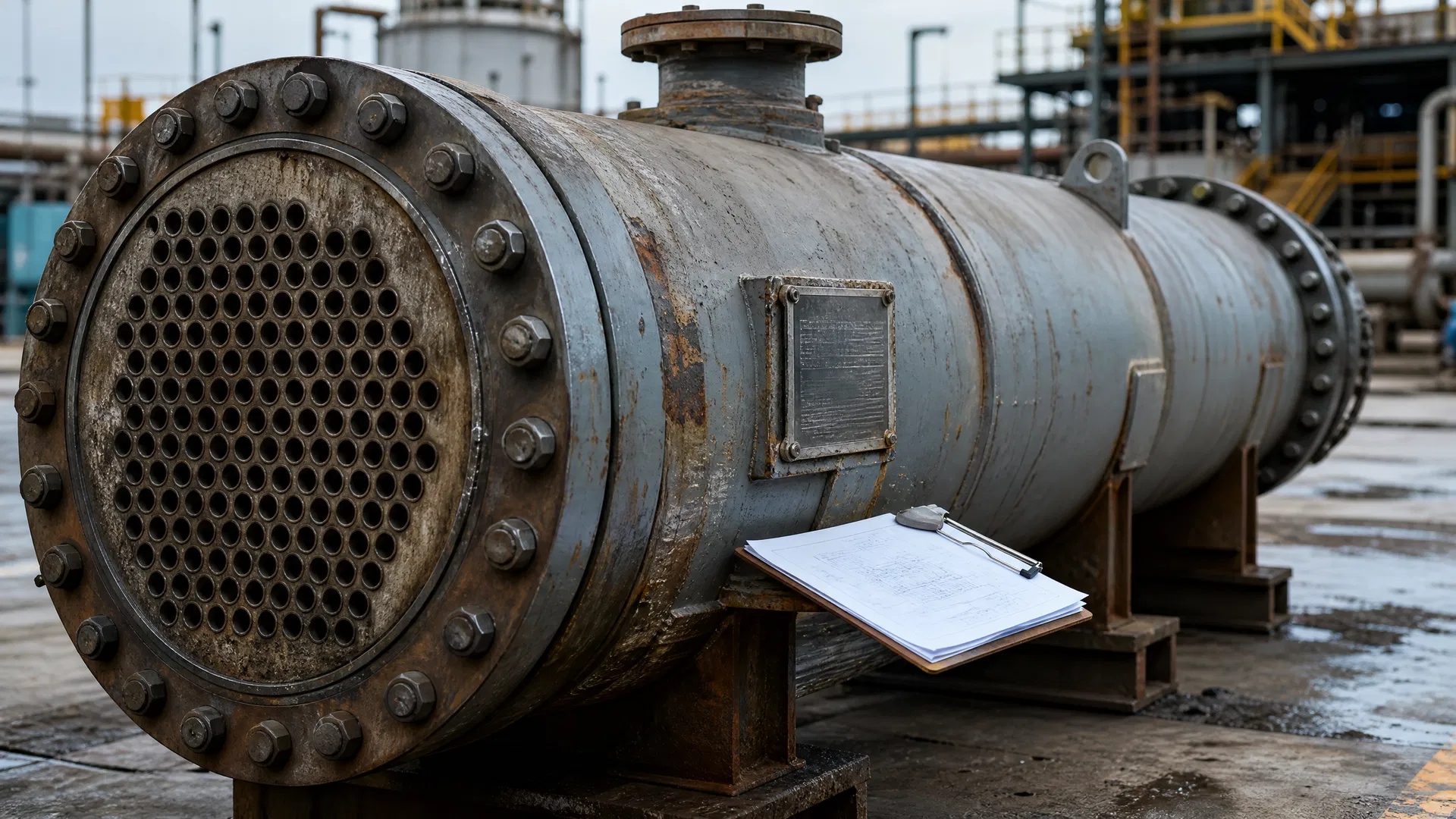
Unused and new-old-stock (NOS) heat exchangers are the most valuable units in the secondary market — we typically pay 50–70% of current new replacement cost for never-installed equipment in original condition. If you have a heat exchanger that was purchased for a project that was cancelled, a spare that was never needed, or a unit that has been sitting in warehouse storage since delivery, Surplus Heat Exchangers will buy it for cash at premium pricing that far exceeds what any scrap dealer or auction house will offer.
Surplus Heat Exchangers buys used and surplus heat exchangers nationwide — 100% upfront, with free rigging and freight, in any condition. Send a photo of the nameplate to 951-403-5738 for a same-day cash offer.
Why NOS Heat Exchangers Command Premium Pricing
A new-old-stock heat exchanger represents the best possible value proposition for a secondary market buyer: they get a unit with zero operating hours, full remaining design life, complete documentation, and original manufacturer warranty eligibility — at 30–50% less than ordering new from the OEM. This savings, combined with immediate availability (versus 12–26 week new-build lead times), creates intense demand for NOS equipment.
For you as the seller, this demand translates directly into higher cash offers. While a used heat exchanger in good condition might sell for 25–40% of new cost, an unused unit in original condition commands 50–70% — sometimes more for hard-to-source sizes, materials, or configurations. The premium reflects the buyer's confidence that they are getting essentially new equipment without the wait or full new-equipment cost.
At Surplus Heat Exchangers, we actively seek NOS inventory because our buyer network includes facilities with urgent needs that cannot wait for new fabrication. A refinery that loses an exchanger during a turnaround needs a replacement in days, not months. A chemical plant expanding capacity needs additional exchangers immediately to meet production deadlines. These buyers will pay premium prices for NOS units that match their specifications — and we pass that premium value through to you in our purchase offer.
What Qualifies as New-Old-Stock?
We define NOS broadly to capture maximum value for sellers:
Never installed, original condition: The unit was delivered from the manufacturer, stored, and never connected to a process system. It may still have shipping covers on nozzles, original paint, and factory test documentation. This is the highest-value category.
Installed but never operated: The unit was physically installed (piped in, bolted down) but the system was never commissioned or the unit never saw process fluid. Common with cancelled projects where construction was partially completed. Still commands near-NOS pricing.
Briefly operated then removed: The unit ran for a short period (days to weeks) before being removed due to process changes, design errors, or project cancellation. With minimal operating hours and no significant wear, these units are valued close to NOS levels.
Purchased as spare, never used: Spare units purchased for emergency replacement that were never needed. May have been in storage for years or decades. Age does not significantly reduce value if the unit was properly stored and shows no deterioration.
Common Sources of NOS Heat Exchangers
NOS inventory accumulates in predictable situations:
- Cancelled capital projects: Equipment purchased for plant expansions, new facilities, or process modifications that were cancelled due to budget cuts, regulatory changes, or market conditions. The equipment was delivered and stored but never installed.
- Over-procurement: Multiple units purchased for redundancy or phased installation where not all units were ultimately needed.
- Design changes: Equipment purchased based on preliminary engineering that was superseded by revised designs requiring different specifications.
- Facility closures before commissioning: New plants or expansions that were built but never started up due to economic conditions, permitting issues, or ownership changes.
- Emergency spares: Critical spares purchased for insurance against unplanned failures that never occurred during the equipment's service life.
- Distributor/dealer inventory: Equipment dealers or distributors with aging inventory that needs to be liquidated.
NOS Value vs. Used Value vs. Scrap Value
| Condition | Typical value (% of new cost) | Key value drivers | Best buyer type |
|---|---|---|---|
| New-old-stock (perfect) | 50–70% | Zero hours, full docs, immediate availability | End users with urgent needs |
| NOS with minor storage wear | 40–60% | Zero hours, cosmetic issues only, docs available | End users willing to refurbish cosmetics |
| Used, excellent condition | 25–40% | Low hours, good wall thickness, documentation | End users, remanufacturers |
| Used, fair condition | 15–25% | Moderate wear, usable with some repair | Remanufacturers, parts buyers |
| Used, poor condition | 5–15% | Significant wear, limited reuse potential | Parts recovery, alloy value |
| Scrap only | 2–8% | Material weight × scrap price per pound | Scrap yards, metal recyclers |
The gap between NOS value and scrap value is enormous. A 316 stainless steel shell-and-tube exchanger that costs $85,000 new might be worth $50,000–$60,000 as NOS, $25,000–$35,000 used in good condition, but only $4,000–$6,000 as scrap metal. Sending NOS equipment to a scrap yard is literally throwing away $45,000–$55,000 in value.
Documentation That Maximizes NOS Value
NOS units with complete documentation command the highest prices because buyers can verify specifications without uncertainty. The most valuable documents include:
- ASME U-1 Data Report: The manufacturer's data report certifying code compliance. This is the single most important document for any ASME pressure vessel.
- Material Test Reports (MTRs): Certified mill test reports for all pressure-retaining materials. Proves the alloy composition and mechanical properties.
- Manufacturer's drawings: General arrangement, tube layout, and detail drawings showing exact dimensions and construction.
- Hydrostatic test certificate: Documentation of the factory pressure test confirming leak-free construction.
- Original purchase order: Shows the original specifications, price, and delivery date — useful for establishing provenance and value.
- Warranty documentation: Some manufacturer warranties transfer with the equipment if it has never been operated.
If you have any of these documents, include them when you contact us. Missing documentation does not prevent a sale — we buy undocumented NOS units regularly — but complete documentation typically adds 10–15% to the offer because it eliminates uncertainty for the end buyer.
Storage Conditions and Their Impact on Value
How a NOS unit was stored affects its condition and therefore its value:
Indoor, climate-controlled storage: Ideal. Unit should be in near-factory condition regardless of storage duration. Full NOS pricing applies.
Indoor, non-climate-controlled storage: Good. May develop light surface oxidation on carbon steel components but no structural impact. 90–100% of NOS pricing.
Outdoor, covered (under roof or tarp): Acceptable. Protected from direct rain but exposed to humidity. May have moderate surface rust on carbon steel. 80–95% of NOS pricing depending on duration and climate.
Outdoor, uncovered: Least ideal for NOS. Rain exposure through open nozzles can cause internal corrosion. Surface rust on carbon steel will be significant. However, stainless steel and exotic alloy units tolerate outdoor storage well. 60–90% of NOS pricing depending on material and duration.
Regardless of storage conditions, if the unit has never been operated, it retains significant NOS premium over used equipment. Even a rusty NOS unit stored outdoors for a decade is worth substantially more than a similar used unit with thousands of operating hours.
Sell Your NOS Heat Exchanger to Us
If you have unused heat exchangers sitting in storage — whether purchased last year or twenty years ago — Surplus Heat Exchangers wants to buy them at premium NOS pricing. We purchase NOS units from all manufacturers, in all materials, in any size. Single units or entire warehouse inventories.
Stop paying to store equipment you will never install. Convert that frozen capital into cash today. Call us at 951-403-5738 or use our secure online quote form with your nameplate data, documentation, and photos. We provide premium NOS valuations within 24 hours. Get your premium cash offer today.