

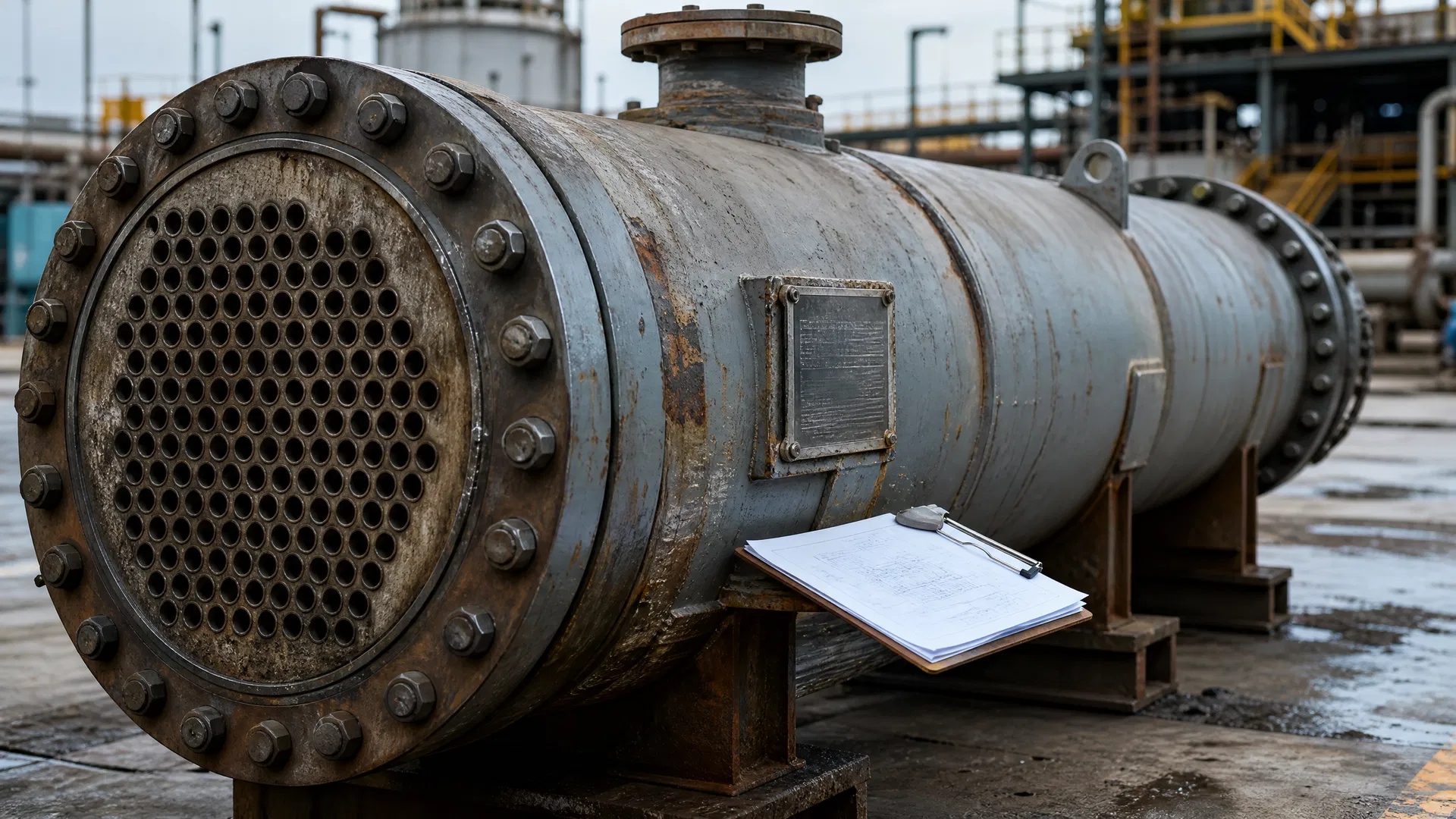
There is no age at which a heat exchanger becomes unsellable. We buy units from brand-new surplus to 50+ years old. Age affects value primarily through its impact on remaining wall thickness, code compliance, and material condition — not through the calendar date alone. In fact, many older heat exchangers (pre-1990s) were built with heavier wall thicknesses, more generous corrosion allowances, and higher-quality alloys than modern cost-optimized designs, making them more valuable in the secondary market, not less.
Surplus Heat Exchangers buys used and surplus heat exchangers nationwide — 100% upfront, with free rigging and freight, in any condition. Send a photo of the nameplate to 951-403-5738 for a same-day cash offer.
The Age Myth: Why Old Does Not Mean Worthless
One of the most common misconceptions we encounter is sellers assuming their 20, 30, or 40-year-old heat exchanger has no value beyond scrap. This belief costs facility owners tens of thousands of dollars in lost recovery value every year. The truth is that age is one of the least important factors in our valuation — far behind material type, condition, size, and documentation.
Consider the economics: a new shell-and-tube heat exchanger with titanium tubes, built to ASME Section VIII standards, costs $150,000–$500,000+ depending on size. A 30-year-old unit of the same specifications, with adequate remaining wall thickness and sound internals, can serve another 15–20 years in appropriate service. The secondary market buyer saves 40–70% compared to ordering new, avoids 16–30 weeks of fabrication lead time, and gets a unit that has already proven itself in service. That is why we pay substantial prices for older equipment.
The industrial heat exchanger market is not like the used car market. Cars depreciate on a predictable curve because they have finite mechanical lifespans and become technologically obsolete. Heat exchangers are simple pressure vessels with no moving parts, no electronics, and no obsolescence — a 1985 shell-and-tube exchanger performs identically to a 2025 unit of the same specifications. The only question is whether the metal is still sound.
When Age Actually Increases Value
Counterintuitively, older heat exchangers are sometimes worth more than newer equivalents. Here is why:
Heavier construction: Before the widespread adoption of computer-optimized design in the 1990s and 2000s, heat exchangers were designed with more conservative corrosion allowances and thicker walls. A 1975-vintage exchanger might have 1/4" corrosion allowance on the shell where a modern equivalent has 1/8". That extra metal means more remaining life and a higher resale value.
Better alloys in older units: Some older exchangers were built during periods when material specifications were more conservative. Vintage copper-nickel and Monel units, for example, were sometimes fabricated from material with higher nickel content than modern minimum-specification equivalents.
Proven service history: A heat exchanger that has operated successfully for 25 years without failure has demonstrated its integrity in a way that a new, untested unit cannot. Buyers in the secondary market value this proven track record.
Discontinued designs: Some older heat exchangers were built to designs or specifications that are no longer manufactured. If a plant needs an exact replacement for an existing unit in a matched pair or series, a used unit of the same vintage and design is worth a premium because the alternative is custom fabrication.
How ASME Code Year Affects Resale
Every ASME-stamped heat exchanger is built to a specific edition of the Boiler and Pressure Vessel Code. The code year is stamped on the nameplate and documented in the U-1 Data Report. Some buyers and jurisdictions have concerns about very old code stamps, but the reality is more nuanced than "old code = unsellable."
The ASME code has evolved over decades, but the fundamental design principles have remained consistent. A vessel built to the 1971 edition of Section VIII Division 1 is not inherently less safe than one built to the 2023 edition — it was designed to the accepted engineering standards of its time, and those standards were already highly conservative.
For resale purposes, code year matters primarily in two scenarios: (1) jurisdictions that require vessels to meet current code for new installations (rare — most accept the code of construction), and (2) buyers who need to rerate the vessel for different service conditions, which requires calculations per the original code of construction.
In our experience, code year has minimal impact on value for most transactions. We buy and resell heat exchangers from every code era, from 1960s vintage to current production. The key factors remain material condition, wall thickness, and documentation — not the edition number on the nameplate.
Age Ranges and Typical Value Impact
| Age range | Typical condition | Value impact vs. new | Key considerations |
|---|---|---|---|
| 0–5 years (NOS/like-new) | Excellent; minimal service wear | 50–80% of new price | Premium pricing; may still have warranty transfer potential |
| 5–15 years | Good; normal service wear | 30–60% of new price | Sweet spot for resale; proven but plenty of life remaining |
| 15–25 years | Fair to good; depends on service | 20–45% of new price | Wall thickness and tube condition are key; documentation helps significantly |
| 25–40 years | Variable; service-dependent | 15–35% of new price | Heavier vintage construction often compensates for age; alloy value dominates |
| 40+ years | Highly variable | 10–30% of new price (or higher for exotic alloys) | Material value drives pricing; reuse possible if wall thickness is adequate |
These ranges are general guidelines. Specific units may fall well outside these ranges depending on alloy content, condition, and market demand. A 45-year-old Hastelloy exchanger in good condition can easily be worth more than a 5-year-old carbon steel unit of the same size.
What Actually Determines Remaining Life
Rather than age in years, the factors that actually determine whether a heat exchanger has remaining useful life are:
Remaining wall thickness: This is the single most important factor. If ultrasonic thickness measurements show adequate wall remaining above the minimum required by code calculations, the unit has remaining life regardless of its calendar age. A 40-year-old exchanger with 90% of its original wall thickness remaining is in better shape than a 10-year-old unit that has lost 50% of its wall to aggressive corrosion.
Tube condition: For shell-and-tube exchangers, the tubes are the primary heat transfer surface and the most vulnerable component. Tube condition is assessed by eddy current testing, hydrostatic testing, or visual inspection of tube ends. If tubes are sound (or can be economically replaced), the unit has value.
Metallurgical condition: Some failure mechanisms are time-dependent regardless of wall thickness — creep damage in high-temperature service, hydrogen attack in refinery service, and sensitization in stainless steels. These require specific inspection techniques to detect and are service-specific rather than age-specific.
Preservation history: How the unit was stored after removal from service matters more than how long it operated. A 30-year-old exchanger that was properly preserved (drained, dried, nitrogen-blanketed, blind-flanged) after 20 years of service is in far better condition than a 10-year-old unit that has sat outdoors with open nozzles for 3 years.
Documentation for Older Units
Documentation becomes more important as units age, simply because it provides certainty about specifications that might otherwise be unknown. For older heat exchangers, the most valuable documents are:
- U-1 Data Report: Confirms original materials, design conditions, and code of construction. For units built before computerized record-keeping, this may be the only reliable source of specifications.
- Inspection history: API 510 inspection reports showing wall thickness trends over time demonstrate remaining life quantitatively.
- Repair records: Document any modifications, retubing, or weld repairs that have been performed. These help buyers understand the unit's complete history.
- Original drawings: Particularly valuable for older units where the manufacturer may no longer exist or maintain records.
If you do not have documentation for your older heat exchanger, do not assume it is unsellable. We buy undocumented units regularly. The nameplate alone provides enough information for us to make a competitive offer, and we can often research original specifications through manufacturer archives and National Board records.
Sell Your Old Heat Exchanger to Us
Whether your heat exchanger is 5 years old or 50 years old, we want to buy it. Age alone never disqualifies a unit from our purchasing program. What matters is the material, size, type, and condition — and we buy units in any condition, from pristine to severely corroded.
If you have older equipment sitting in storage, in a laydown yard, or still installed in a decommissioned system, it is losing value every day to atmospheric corrosion and weather exposure. The best time to sell is now, before further deterioration reduces your offer.
Call Surplus Heat Exchangers at 951-403-5738 or send photos and nameplate data to our secure online quote form. We provide free, no-obligation cash offers on heat exchangers of any age, any condition, anywhere in the United States. Get your cash offer today.