
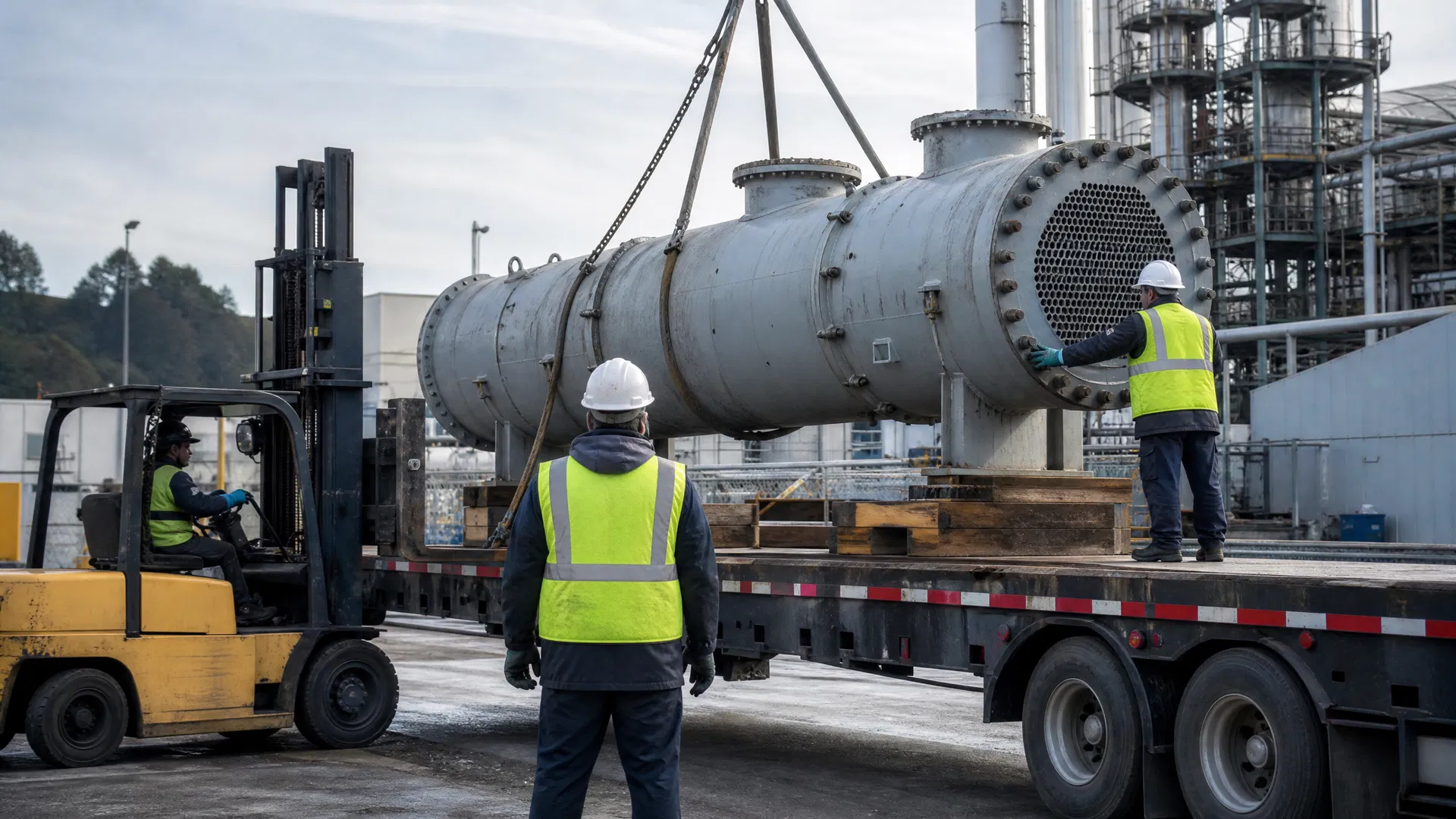
When you sell your heat exchanger to Surplus Heat Exchangers, you do not need to worry about rigging, crane service, loading, or shipping — we handle all logistics at no cost to you. Our nationwide network of heavy-haul carriers and industrial riggers removes units weighing from 500 pounds to 500,000+ pounds from any location in the United States. You simply grant site access, and we do the rest.
Surplus Heat Exchangers buys used and surplus heat exchangers nationwide — 100% upfront, with free rigging and freight, in any condition. Send a photo of the nameplate to 951-403-5738 for a same-day cash offer.
Why Logistics Should Never Stop You From Selling
One of the most common reasons plant managers delay selling surplus heat exchangers is the perceived difficulty of moving them. A 40,000-pound shell-and-tube exchanger sitting 30 feet up in a pipe rack seems like an impossible logistics problem — and it would be, if you had to solve it yourself. But you do not.
At Surplus Heat Exchangers, logistics is our problem, not yours. We have removed heat exchangers from offshore platforms, underground vaults, rooftop mechanical rooms, congested refinery pipe racks, and remote power stations accessible only by barge. Every purchase we make includes full-service removal at our expense. The price we quote you is the price you receive — there are no deductions for rigging, crane rental, or freight.
This means the only thing standing between you and a cash payment is a phone call. Whether your exchanger is ground-level on saddles or elevated in a structural steel framework, whether it weighs 2,000 pounds or 200,000 pounds, whether your site is in downtown Houston or rural Montana — we have the capability and experience to extract it safely and efficiently.
How We Plan a Heat Exchanger Removal
Every removal begins with a logistics assessment. When you accept our purchase offer, our operations team contacts you to gather the information needed to plan the extraction:
Site access: What is the path from the exchanger's current location to the nearest crane-accessible area? Are there overhead obstructions (pipe racks, power lines, buildings)? What is the ground condition — paved, gravel, or soft soil that requires crane mats? Are there weight restrictions on access roads or bridges?
Unit configuration: Is the exchanger installed (still connected to piping) or already disconnected and sitting in a laydown area? If installed, what disconnection work is required — blind flanges, pipe cuts, insulation removal? Who will perform the disconnection — your maintenance team, or do you need us to arrange it?
Rigging plan: Based on the unit's weight, dimensions, location, and surrounding obstructions, our riggers develop a lift plan specifying crane size, rigging configuration (spreader bars, slings, shackles), and lift sequence. For complex lifts, we provide engineered lift plans stamped by a Professional Engineer.
Permitting: Oversize and overweight loads require state DOT permits for highway transport. We handle all permit applications, route surveys, and escort vehicle arrangements. For loads exceeding standard dimensions, we coordinate with utilities for power line raises and with municipalities for traffic control.
Crane Selection: Matching the Right Equipment to Your Job
Selecting the right crane is critical for safe, efficient heat exchanger removal. The choice depends on the unit's weight, the required reach (how far the crane must extend to access the unit), and site constraints. Here is how we match cranes to typical scenarios:
| Exchanger weight | Typical crane size | Reach capability | Typical scenario |
|---|---|---|---|
| Under 5,000 lbs | 25–50 ton hydraulic | 40–80 ft | Small coolers, plate exchangers at ground level |
| 5,000–20,000 lbs | 50–100 ton hydraulic | 50–120 ft | Medium shell-and-tube units, pipe rack elevation |
| 20,000–50,000 lbs | 100–200 ton hydraulic | 60–150 ft | Large exchangers, elevated installations |
| 50,000–100,000 lbs | 200–400 ton crawler or hydraulic | 80–200 ft | Feedwater heaters, large condensers |
| 100,000–300,000 lbs | 400–750 ton crawler | 100–250 ft | Power plant exchangers, offshore modules |
| Over 300,000 lbs | 750+ ton crawler or tandem lift | Varies | Surface condensers, very large vessels |
For units that cannot be reached by a single crane due to obstructions or extreme weight, we employ tandem lifts (two cranes working in coordination), gantry systems, or jack-and-slide techniques. These specialized methods allow us to extract equipment from locations that seem physically impossible to access with conventional rigging.
Transport Options: Getting Your Exchanger to Our Facility
Once the heat exchanger is on the ground and loaded, it needs to travel to either our yard, a buyer's facility, or a remanufacturing shop. The transport method depends on the unit's dimensions and weight:
Standard flatbed trailer: For units under 48,000 pounds and within standard dimensions (8.5 feet wide, 13.5 feet tall, 53 feet long). Most small-to-medium heat exchangers ship on standard flatbeds with no special permits required.
Step-deck (drop-deck) trailer: For taller units that exceed the 13.5-foot height limit on a standard flatbed. The lower deck height provides an additional 18–24 inches of clearance. Common for vertical exchangers laid on their side.
RGN (Removable Gooseneck) trailer: For very heavy or oversized units. RGN trailers allow the front to detach and the deck to slope to ground level, enabling roll-on loading of extremely heavy equipment. Capacity up to 80,000+ pounds on multi-axle configurations.
Multi-axle heavy-haul trailer: For loads exceeding 80,000 pounds. These specialized trailers with 9–19 axle lines can transport loads up to 500,000+ pounds. They require overweight permits, route surveys, bridge analysis, and escort vehicles, all of which we arrange.
Barge transport: For waterfront facilities or extremely heavy loads where highway transport is impractical. We coordinate barge loading, marine transport, and offloading at destination ports.
What You Need to Provide (Almost Nothing)
When you sell to us, your responsibilities are minimal:
- Site access: Grant our rigging crew access to the equipment location. Provide a site contact who can answer questions about access routes and obstructions.
- Disconnection (if applicable): If the unit is still connected to piping, either disconnect it before our arrival or let us know so we can arrange disconnection services. Many sellers prefer to have their own maintenance team disconnect the unit since they know the system best.
- Safety orientation: If your site requires contractor safety orientation, provide the requirements in advance so our crew arrives prepared.
That is it. You do not need to arrange cranes, hire riggers, book freight, obtain permits, or coordinate any aspect of the physical removal. We handle everything from the moment you accept our offer until the unit leaves your property.
Timeline: How Long Does Removal Take?
From offer acceptance to equipment removal, typical timelines are:
- Ground-level units, standard size: 3–7 business days (crane + flatbed scheduling)
- Elevated units requiring crane extraction: 5–14 business days (crane scheduling + rigging planning)
- Very large or complex removals: 14–30 business days (engineered lift plan + heavy-haul permitting)
- Emergency/rush removal: 1–3 business days (available for urgent situations at no additional cost)
These timelines can be shortened or extended based on your schedule. If you need the equipment removed by a specific date (shutdown deadline, lease expiration, demolition schedule), tell us upfront and we will plan accordingly. If you are flexible on timing, we can often combine your removal with other pickups in the area, which helps us serve you faster.
Insurance and Liability During Removal
Our rigging contractors carry comprehensive insurance including general liability, workers' compensation, and equipment/property damage coverage. We provide certificates of insurance to your facility before any work begins. During the removal process, our contractors are responsible for any damage to your property or equipment caused by their operations.
Once the heat exchanger is loaded on our transport vehicle, ownership and risk transfer to us completely. You have no further liability or responsibility for the equipment from that point forward.
Real Examples: Removals We Have Completed
To illustrate our capabilities, here are representative examples of heat exchanger removals we have performed:
- Refinery turnaround — 12 exchangers in 3 days: Removed twelve shell-and-tube exchangers (8,000–35,000 lbs each) from a pipe rack during a scheduled turnaround. Coordinated with the refinery's turnaround contractor to sequence our lifts between their maintenance activities.
- Power plant closure — surface condenser: Extracted a 280,000-pound surface condenser from a turbine hall using a 500-ton crawler crane with a 180-foot boom. Required removal of a building wall section and construction of a temporary crane pad.
- Rooftop mechanical room — 4 plate exchangers: Removed four plate-and-frame exchangers from a 6th-floor mechanical room in a commercial building. Used a 100-ton hydraulic crane positioned in the parking lot to lift units off the roof through an access hatch.
- Offshore platform — via barge: Purchased and removed heat exchangers from a decommissioned offshore platform in the Gulf of Mexico. Equipment was craned onto a supply vessel, transported to shore, and loaded onto trucks at a marine terminal.
Ready to Sell? We Handle the Hard Part
Do not let logistics concerns prevent you from recovering the value of your surplus heat exchangers. Whether your unit is on the ground floor or 100 feet in the air, whether it weighs 1,000 pounds or 300,000 pounds, we have the equipment, experience, and network to remove it safely and efficiently — at absolutely no cost to you.
Call Surplus Heat Exchangers at 951-403-5738 or use our secure online quote form. Tell us what you have, where it is, and any access constraints. We will provide a cash offer and a removal plan. You get paid 100% upfront, and we handle everything else. Get your cash offer today.