
You can typically sell a used heat exchanger and receive a cash offer within 24 to 48 hours when working with a specialized surplus buyer. The entire process, from submitting photos and nameplate data to receiving 100% upfront payment and scheduling freight removal, can often be completed in under a week. Having clear documentation and working with a buyer who handles their own logistics are the biggest factors in speeding up the sale.
Surplus Heat Exchangers buys used and surplus heat exchangers nationwide — 100% upfront, with free rigging and freight, in any condition. Send a photo of the nameplate to 951-403-5738 for a same-day cash offer.
How long does it take to sell a used heat exchanger?
Selling a used or surplus heat exchanger can take anywhere from a single day to several months, depending entirely on the sales channel you choose. If you attempt to sell the equipment yourself through online marketplaces, industrial auctions, or by searching for an end-user, the process can drag on for 60 to 120 days. You have to wait for a buyer who needs your exact specifications, negotiate terms, and figure out the logistics of moving a massive piece of industrial equipment.
However, when you sell directly to a dedicated buyer like Surplus Heat Exchangers, the timeline shrinks dramatically. Because we purchase equipment for our own inventory, we do not need to wait for an end-user. We can evaluate your unit, make a firm cash offer within 24 to 48 hours, and issue 100% upfront payment before the unit ever leaves your facility. Once payment is secured, the timeline for removal depends mostly on your schedule and the availability of flatbed trucks, but the financial transaction is completed almost immediately.
What factors speed up the heat exchanger selling process?
The speed of your transaction relies heavily on the quality of the information you provide upfront. Industrial heat exchangers are highly engineered assets, and buyers need specific data to determine their value, whether they are destined for resale or material recovery.
To accelerate the process, the most critical step is providing clear, legible photos of the manufacturer's nameplate. The nameplate contains the DNA of the unit, including the serial number, model number, year of manufacture, design pressures, and temperature ratings. For brands like Alfa Laval, GEA, Tranter, Standard Xchange, ITT, SPX/APV, Kelvion, and SWEP, this data allows buyers to instantly cross-reference the unit's specifications.
Additionally, providing a general arrangement (GA) drawing or a U-1A manufacturer's data report will significantly expedite the evaluation. These documents confirm the materials of construction, the number of tubes, tube diameter, and shell thickness. When a buyer has this information immediately, they do not have to make conservative estimates, allowing them to issue a faster, more accurate offer.
How do materials and TEMA types affect the timeline?
The materials of construction and the specific TEMA (Tubular Exchanger Manufacturers Association) designation play a major role in how quickly a unit can be evaluated and purchased. Heat exchangers built from high-value, corrosion-resistant alloys are always in high demand and can be processed very quickly.
For example, if your unit features a titanium or Hastelloy tube bundle, buyers will move rapidly to secure the asset. Even if the unit is beyond repair and destined for scrap, the base material values are substantial. Current scrap values for industrial metals fluctuate, but typical ranges include carbon steel at only a baseline commodity rate, 304 stainless steel at only a baseline commodity rate, and 316 stainless steel at only a baseline commodity rate. Higher-end non-ferrous metals command even more, with copper at only a baseline commodity rate, admiralty brass at only a baseline commodity rate, cupro-nickel at only a baseline commodity rate, and titanium reaching only a baseline commodity rate.
TEMA types also influence the speed of the sale. TEMA type BEM (bonnet, fixed tubesheet) or AES (channel, floating head) shell and tube heat exchangers are standard in the petrochemical and refining industries. Because their applications are so broad, their resale market is highly liquid. A standard shell and tube unit in good condition can resell for roughly a significant premium over scrap based on its heat-transfer surface area, depending on the materials and pressure ratings. Plate and frame heat exchangers from manufacturers like Alfa Laval or Tranter are also evaluated quickly because their modular nature makes them easy to refurbish.
What information do buyers need to make a fast offer?
To ensure you get an offer within 24 hours, you should compile a specific set of data points before contacting a buyer. Having this information ready eliminates the back-and-forth communication that typically delays a sale.
- Clear Nameplate Photos: Ensure the text is legible. If the nameplate is dirty, wipe it down before photographing.
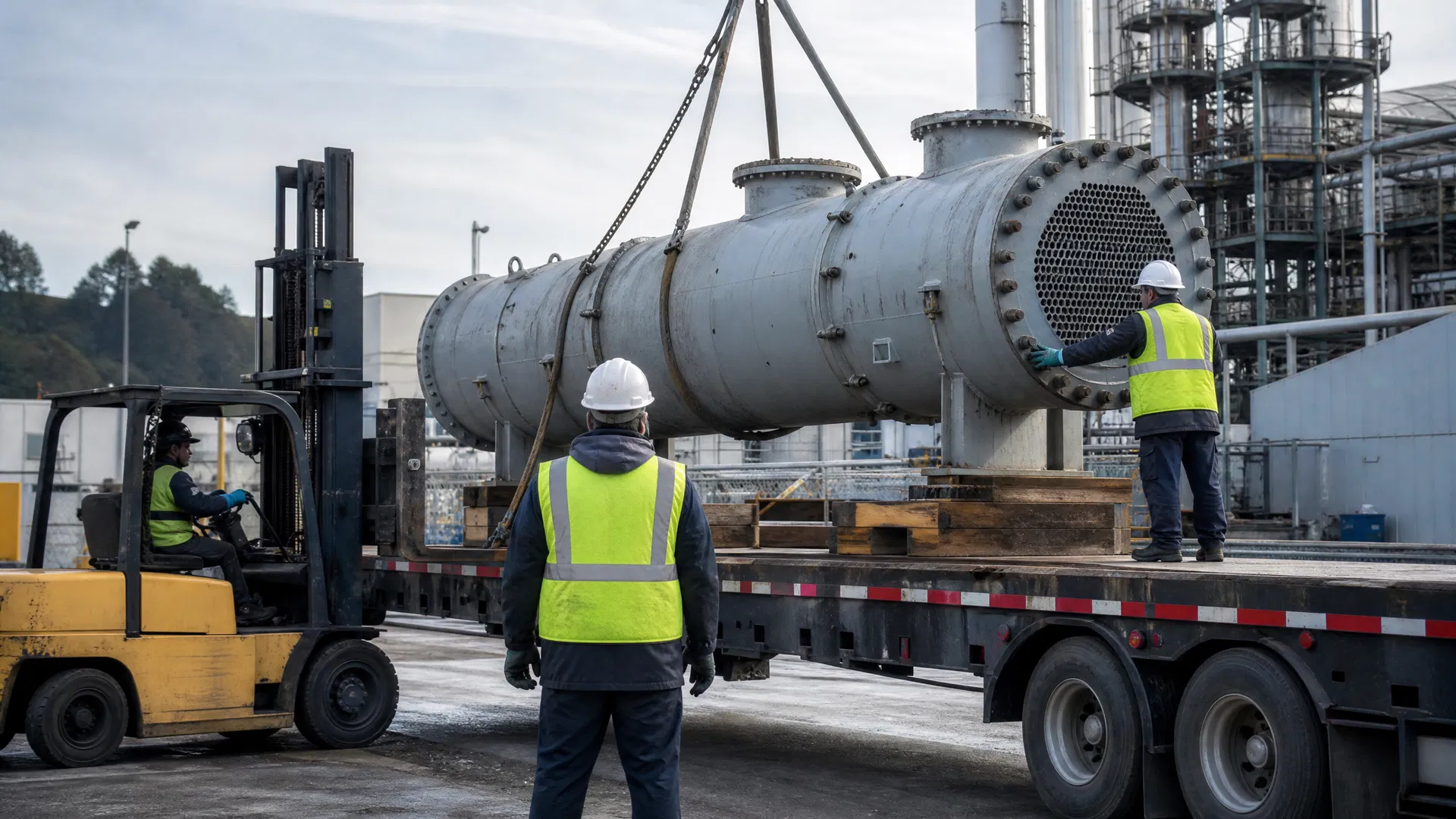
- Overall Unit Photos: Take wide shots showing the entire unit, as well as close-ups of the nozzles, flanges, and any visible damage.
- Dimensional Data: Provide the overall length, width, height, and estimated empty weight. This is crucial for calculating freight costs.
- Material Specifications: Identify the materials for the shell, tubes, tubesheets, and channels. The original U-1 form will list all materials perfectly.
- Current Condition and Status: Note whether the unit is currently in service, idle, or already uninstalled and sitting in a laydown yard.
- Reason for Removal: State whether the unit was replaced due to a plant upgrade, a change in process, or a mechanical failure.
When you email this package to our secure online quote form, our team can immediately begin calculating the unit's value based on its resale potential or its base material weight, ensuring you receive the fastest possible response.
How does the condition of the unit impact the sale speed?
A common misconception is that a heat exchanger must be in perfect, working condition to be sold quickly. In reality, specialized surplus buyers purchase equipment in almost any condition, from brand-new surplus units still on their original shipping skids to heavily fouled or damaged units that have been sitting outside for years.
The condition does not necessarily slow down the sale, but it does dictate the valuation method. If a unit is in excellent condition and can be pressure tested and resold, it will be valued based on its heat transfer area and market demand. If a unit has severe tube leaks, a cracked shell, or extensive corrosion, it will be valued based on its recoverable scrap metal weight.
Because Surplus Heat Exchangers buys units in any condition, you do not need to waste time cleaning, hydro-testing, or repairing the equipment before selling it. Attempting to refurbish a unit yourself will only delay the sale and cost you money. We buy the equipment"as-is, where-is," which means you can sell it immediately in its current state.
What is the typical timeline from quote to payment and removal?
Understanding the step-by-step timeline can help plant managers and contractors plan their decommissioning or asset recovery schedules. While every transaction is unique, a typical sale to a direct buyer follows a highly predictable and rapid sequence.
| Step in the Process | Typical Timeframe | Action Required |
|---|---|---|
| 1. Initial Contact & Data Submission | Day 1 | You send photos, nameplate data, and location to the buyer. |
| 2. Evaluation & Cash Offer | Day 1 - Day 2 | Buyer evaluates the asset and issues a formal purchase order. |
| 3. Agreement & Invoicing | Day 2 - Day 3 | You accept the offer and send an invoice for the agreed amount. |
| 4. 100% Upfront Payment | Day 3 - Day 4 | Buyer wires funds or sends a check before the equipment moves. |
| 5. Freight & Logistics Scheduling | Day 4 - Day 7 | Buyer arranges for a flatbed truck and coordinates loading times. |
| 6. Loading & Removal | Day 7 - Day 10 | Your team loads the unit onto the buyer's truck, completing the sale. |
As the table illustrates, the financial portion of the transaction is typically completed within the first few days. The only variable that extends the timeline is the physical logistics of getting a heavy-haul truck to your facility and scheduling the crane or forklift time required to load the unit.
How do logistics and freight arrangements affect the transaction?
One of the biggest bottlenecks in selling heavy industrial equipment is figuring out how to move it. Heat exchangers can weigh anywhere from a few thousand pounds to over 100,000 pounds. If you are responsible for arranging the freight, securing permits for oversized loads, and finding specialized rigging companies, the process can be delayed by weeks.
To eliminate this delay, you should only work with buyers who handle their own logistics. Surplus Heat Exchangers covers all freight costs and manages the transportation logistics entirely. Once you receive your 100% upfront payment, our logistics team will work directly with your shipping department or site manager to schedule a truck. All you need to do is load the unit onto our trailer. By removing the burden of freight management from your shoulders, the transaction is completed much faster and with zero out-of-pocket costs for your company.
How can you sell your surplus heat exchanger immediately?
If you have a used, surplus, or scrap heat exchanger taking up valuable space in your plant or laydown yard, there is no reason to wait months for a buyer. By gathering the right information and partnering with a company that specializes in these assets, you can turn idle equipment into working capital in a matter of days.
Surplus Heat Exchangers is actively buying shell and tube, plate and frame, air-cooled, and spiral heat exchangers across the United States. We buy all major brands, including Standard Xchange, ITT, SPX/APV, and Kelvion, and we purchase units in any condition. We pride ourselves on making fast, fair offers, paying 100% upfront, and handling all the heavy lifting when it comes to freight.
To start the process and get an offer within 24 hours, simply take a few clear photos of your unit and its nameplate. Call us directly at 951-403-5738 or email your information to our secure online quote form. We will review your equipment immediately and provide a firm cash offer, allowing you to clear your yard and monetize your surplus assets without delay.