
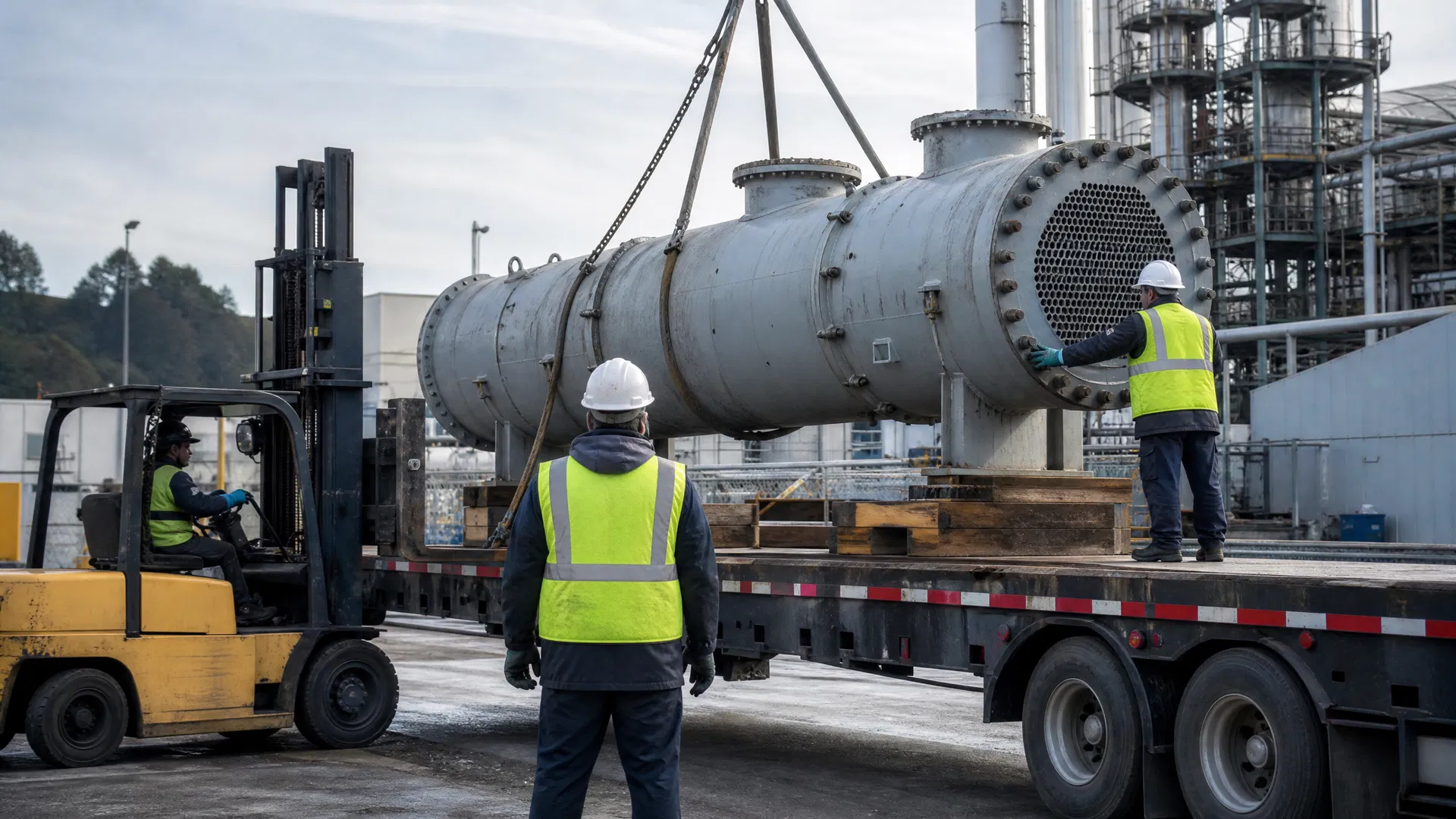
The most common heat exchanger failure modes are tube leaks from corrosion or erosion, shell-side fouling that reduces thermal performance, baffle damage from flow-induced vibration, and tubesheet cracking from thermal cycling. When repair costs approach 40–60% of replacement cost, or when the failure indicates systemic degradation rather than an isolated defect, selling the unit to a direct buyer like Surplus Heat Exchangers typically recovers more capital than investing in another repair cycle.
Surplus Heat Exchangers buys used and surplus heat exchangers nationwide — 100% upfront, with free rigging and freight, in any condition. Send a photo of the nameplate to 951-403-5738 for a same-day cash offer.
Why Failed Heat Exchangers Still Have Significant Value
When a heat exchanger fails in service, the immediate reaction of most plant engineers is to classify it as scrap. This is a costly mistake. A failed heat exchanger — even one with tube leaks, shell corrosion, or baffle damage — contains thousands of pounds of engineered alloy material, precision-manufactured components, and an ASME-coded pressure boundary that has residual value far exceeding its scrap weight.
At Surplus Heat Exchangers, we buy failed and damaged units specifically because our network of repair shops, remanufacturers, and modification facilities can restore or repurpose these components. A leaking tube bundle can be retubed. A corroded shell can be weld-repaired and recertified. Individual components like tubesheets, channel covers, and floating heads can be reused in other builds. The engineering value of these components — the machining, the welding, the code certification — does not disappear just because the unit failed in your specific service.
This means that when you face a repair-or-replace decision, there is a third option that most maintenance managers overlook: sell the failed unit to us for cash, and apply that capital toward your replacement. You recover value from the old unit immediately, clear the laydown space, and avoid the sunk cost of a repair that may only buy you another few years before the next failure.
Tube Leaks: The Most Common Failure Mode
Tube failures account for the majority of heat exchanger shutdowns in process industries. Tubes fail through several mechanisms, each with different implications for repair viability and resale value.
Pitting corrosion creates localized holes in the tube wall, typically on the shell side where corrosive fluids contact the outer tube surface. Pitting is insidious because it can perforate a tube while leaving the surrounding metal apparently sound. If pitting is isolated to a few tubes, plugging those tubes is a viable short-term repair. However, if pitting is widespread across the bundle, it indicates a systemic corrosion mechanism that will continue to produce failures. This is a strong signal to sell rather than repair.
Erosion-corrosion occurs where high-velocity fluid strips the protective oxide layer from tube surfaces, particularly at inlet nozzles and baffle cut areas. Tubes thin progressively until they perforate. Erosion patterns are predictable — they always start at the same locations — so if you have already retubed once for erosion and the replacement tubes are now failing in the same pattern, the exchanger design is fundamentally mismatched to your service conditions. Sell it and specify a more appropriate design for the replacement.
Stress corrosion cracking (SCC) affects specific alloys in specific environments — most commonly austenitic stainless steels (304, 316) in chloride-containing services above 140°F. SCC produces branching, transgranular cracks that propagate rapidly once initiated. If your stainless steel tubes have failed by SCC, retubing with the same alloy is pointless unless you can eliminate the chlorides. This is a case where selling the unit and upgrading to a chloride-resistant alloy (duplex stainless, titanium, or a nickel alloy) makes far more engineering and financial sense.
Vibration-induced fatigue causes tubes to crack at baffle holes or at the tubesheet joint due to flow-induced oscillation. Vibration failures are a design problem — the unsupported tube span is too long for the shell-side flow velocity. Plugging failed tubes reduces the flow area, increases velocity through the remaining tubes, and accelerates the vibration problem. This is a classic case where repair makes the problem worse, and selling is the correct decision.
Shell-Side Corrosion and Erosion
While tubes are the most common failure point, shell-side degradation can also render a heat exchanger uneconomical to repair. Shell corrosion typically manifests as general wall thinning (reducing the pressure rating below the required MAWP), localized pitting under deposits, or erosion at impingement points near inlet nozzles.
When shell wall thickness drops below the minimum required by ASME code calculations, the unit must either be derated to a lower pressure, repaired by weld overlay, or retired from service. Weld overlay repairs on large shells are expensive — typically $15,000–$50,000 depending on the area involved — and they add weight and stress concentrations that may create new problems. If the corrosion is widespread rather than localized, overlay becomes impractical and the shell is effectively at end of life for your service.
However, a shell that is too thin for your 300-psig service may be perfectly adequate for a 150-psig application elsewhere. This is exactly why selling to us makes sense — we match equipment to appropriate services across our buyer network. Your retired unit becomes someone else's perfectly serviceable exchanger at a lower rating, and you receive cash instead of paying for scrap hauling.
Baffle and Support Damage
Baffles direct shell-side flow across the tube bundle and support the tubes against vibration. Over time, baffles erode — particularly in services with abrasive particles, high velocities, or corrosive fluids. Eroded baffles allow tubes to vibrate freely, leading to tube fatigue failures, and they reduce thermal performance by allowing flow to bypass the tube bundle.
Baffle replacement requires pulling the tube bundle, cutting out the old baffles, and installing new ones — essentially a complete remanufacture of the bundle assembly. This is one of the most expensive repairs possible on a shell-and-tube exchanger, often exceeding the cost of a new replacement bundle. If your baffles are severely eroded, selling the unit to us is almost always more economical than rebuilding.
We value units with baffle damage based on the remaining components: the shell, tubesheets, channel covers, and the tube material itself. Even if the baffles are gone, the alloy content of the tubes and the coded shell retain significant value in our resale and remanufacturing network.
Tubesheet Failures
Tubesheet failures are among the most serious because the tubesheet is the pressure boundary between the shell-side and tube-side fluids. Common tubesheet failure modes include ligament cracking (cracks between adjacent tube holes), erosion of the tube-to-tubesheet joints, and corrosion of the tubesheet face.
Ligament cracking is often caused by thermal cycling — repeated heating and cooling creates differential expansion stresses that eventually crack the thin metal bridges between tube holes. Once ligament cracking begins, it tends to propagate across the tubesheet over subsequent thermal cycles. Repair options are limited: you can weld-repair individual cracks, but if the cracking is widespread, the tubesheet must be replaced — a major expense that often exceeds 50% of new equipment cost.
When tubesheet damage is extensive, selling the unit makes strong financial sense. The shell, channel covers, nozzles, and even the tubes (if they are sound) all retain value. We purchase units with tubesheet damage regularly and route them to our remanufacturing partners who specialize in tubesheet replacement and bundle rebuilds.
The Repair-or-Sell Decision Matrix
| Failure mode | Typical repair cost range | Repair makes sense when... | Selling makes sense when... |
|---|---|---|---|
| Isolated tube leaks (1-5 tubes) | $2,000–$8,000 (plug or retube) | Failure is isolated, no systemic pattern | You have already plugged 10%+ of tubes |
| Widespread tube corrosion | $25,000–$80,000 (full retube) | Shell and tubesheet are sound; same alloy is appropriate | Corrosion mechanism will attack new tubes too |
| Shell wall thinning | $15,000–$50,000 (weld overlay) | Thinning is localized to small area | Thinning is widespread; unit needs derating |
| Baffle erosion | $30,000–$100,000+ (bundle rebuild) | Rarely — usually exceeds replacement cost | Almost always — rebuild cost approaches new price |
| Tubesheet cracking | $40,000–$120,000+ (replacement) | Cracking is isolated to 2-3 ligaments | Widespread cracking; thermal cycling will continue |
| Vibration damage | $20,000–$60,000 (retube + anti-vibration) | Root cause can be eliminated (flow reduction) | Design is fundamentally mismatched to service |
| Stress corrosion cracking | $25,000–$80,000 (retube with upgraded alloy) | Upgraded alloy solves the problem permanently | Service conditions cannot be changed; unit is wrong alloy |
How We Value Damaged Heat Exchangers
When you sell a damaged heat exchanger to Surplus Heat Exchangers, we do not simply weigh it and pay scrap price. We evaluate the unit based on what can be recovered, reused, or remanufactured from its components:
- Shell value: An ASME-coded shell in reasonable condition has significant value as a pressure vessel, even if the internals are damaged. Shells can be retubed, rebaffled, and returned to service.
- Tube material value: Even damaged tubes have value based on their alloy content. Titanium tubes, stainless tubes, and copper-alloy tubes command premium prices whether they are reusable or destined for alloy recycling (which pays far more than mixed-metal scrap).
- Tubesheet value: Sound tubesheets — particularly those made from expensive alloys like Monel, titanium-clad, or naval brass — are valuable components for remanufacturers.
- Channel covers, floating heads, and bonnets: These precision-machined components are expensive to manufacture new and are readily reusable if undamaged.
- Flanges and nozzles: High-pressure flanges (600# and above) and large-bore nozzles have standalone value.
This component-level valuation means we can typically offer significantly more than scrap price for a damaged unit, because we are paying for the engineering value of individual components rather than just the gross weight of mixed metal.
When Repair Is Clearly the Wrong Choice
Based on our experience purchasing thousands of failed heat exchangers, here are the scenarios where repair almost never makes financial sense:
- The unit has been repaired multiple times for the same failure mode. Recurring failures indicate a systemic problem that repair cannot solve. Each repair cycle costs more and buys less time.
- Repair cost exceeds 40-60% of new replacement cost. At this threshold, you are better off buying new (with a full warranty and expected service life) and selling the old unit to us for cash to offset the purchase.
- The failure mode will recur because service conditions cannot change. If your process requires chloride-containing fluids at elevated temperatures and your 316 stainless tubes keep cracking, retubing with 316 again is throwing money away.
- The unit is already derated or has significant prior repairs. Each repair adds complexity, stress concentrations, and uncertainty. At some point, the accumulation of repairs makes the unit unreliable regardless of the latest fix.
- The unit is obsolete for your current process. If you have already redesigned the process, upgraded capacity, or changed fluids, repairing an exchanger that no longer fits your needs is pointless. Sell it to someone whose process it does fit.
How to Sell Your Failed Heat Exchanger to Us
Selling a damaged or failed heat exchanger to Surplus Heat Exchangers is straightforward. We buy units in any condition — leaking, corroded, vibration-damaged, or completely failed. Here is what we need from you:
Send us photos of the nameplate, the overall unit, and the damage area. Tell us what failed and how (if you know). If you have inspection reports, UT readings, or failure analysis results, include those — they help us see the full picture and often result in a higher offer because we can identify which components are still sound.
We will provide a cash offer, typically within 24 hours. If you accept, we pay 100% upfront before pickup, and we handle all rigging and freight at no cost to you. You clear the failed equipment from your site, recover capital, and can apply those funds toward your replacement unit.
Do not let a failed heat exchanger sit in your laydown yard losing value to weather exposure. The longer damaged equipment sits, the more secondary damage occurs from rain, UV, and atmospheric corrosion. Call us at 951-403-5738 or use our secure online quote form to get a cash offer today.