

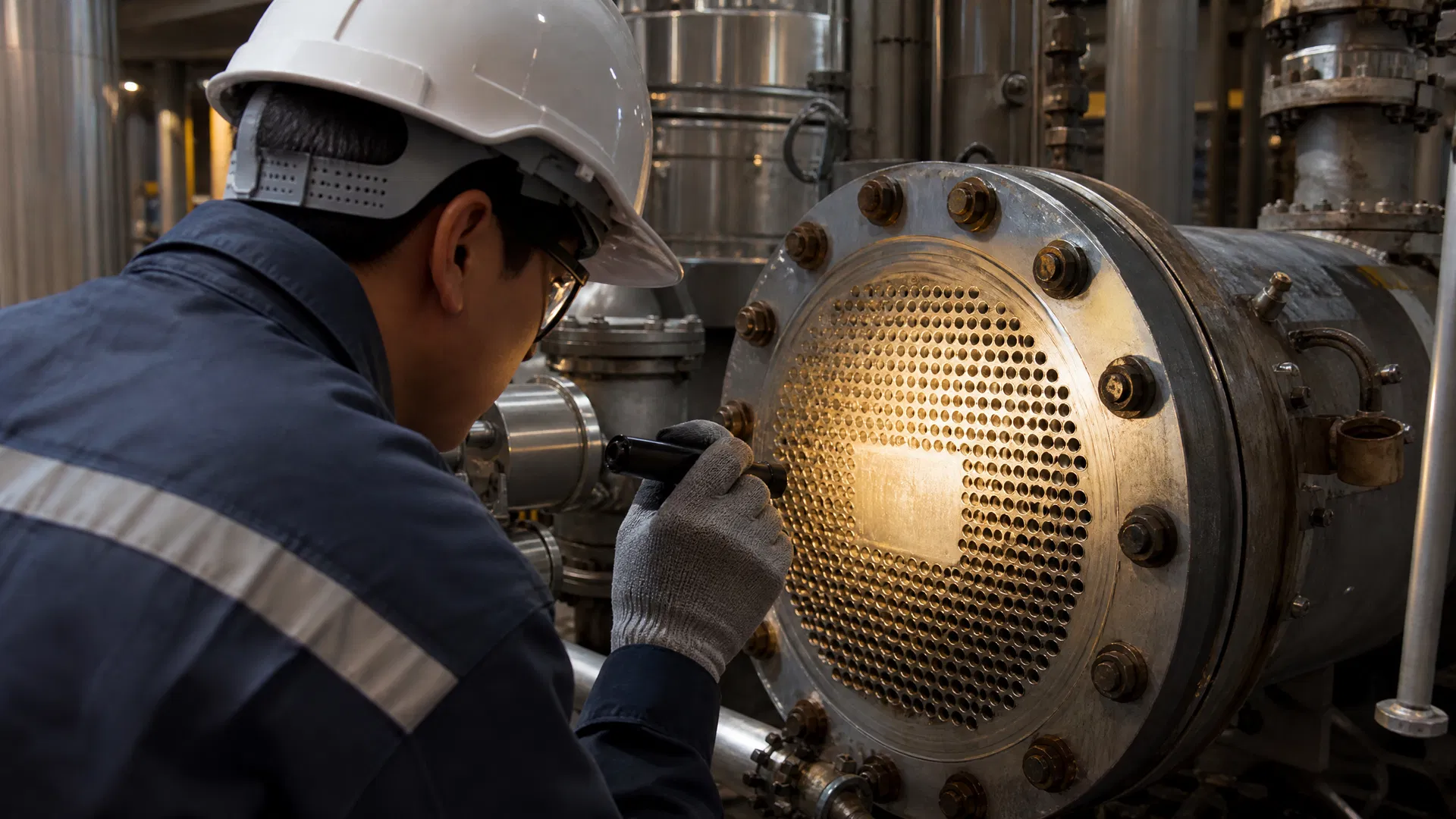
TEMA classification is a standardized system developed by the Tubular Exchanger Manufacturers Association that defines the mechanical design, construction, and application class of shell and tube heat exchangers. When selling your used equipment, its TEMA class (R, C, or B) and specific three-letter designation (like BEM or AEL) directly dictate its resale value, as these codes tell buyers exactly what pressures, temperatures, and industrial processes the unit can handle.
Surplus Heat Exchangers buys used and surplus heat exchangers nationwide — 100% upfront, with free rigging and freight, in any condition. Send a photo of the nameplate to 951-403-5738 for a same-day cash offer.
What exactly is TEMA classification for heat exchangers?
The Tubular Exchanger Manufacturers Association (TEMA) established a comprehensive set of standards to ensure the safe and reliable design, fabrication, and operation of shell and tube heat exchangers. In the industrial processing world, a TEMA classification acts as a universal language. Instead of exchanging lengthy engineering drawings just to understand the basic geometry of a unit, engineers and equipment buyers can look at a simple three-letter code and a class designation to know exactly what they are dealing with.
When you are looking to sell a used or surplus heat exchanger from your facility, the TEMA classification on the manufacturer's nameplate is one of the most critical pieces of information you can provide. It instantly communicates the unit's structural integrity, its intended industrial application, and its physical configuration. Whether your equipment was manufactured by Standard Xchange, ITT, Kelvion, Alfa Laval, GEA, Tranter, SPX/APV, or SWEP, the TEMA standard applies to shell and tube designs across the board. Buyers at Surplus Heat Exchangers use this classification to quickly assess the unit's secondary market demand, allowing us to make fast, accurate, and competitive cash offers for your surplus assets.
How do TEMA classes (R, C, and B) impact the resale value of your equipment?
TEMA divides shell and tube heat exchangers into three distinct mechanical standards or"classes" based on the severity of the operating conditions. The class of your heat exchanger significantly impacts its original cost and, consequently, its current resale or scrap value.
Class R (Refinery and Severe Service): This is the most robust and heavily built classification. Class R heat exchangers are designed for the rigorous demands of the petroleum and related processing industries. They feature thicker tube sheets, heavier shell walls, and more substantial bolting to handle extreme pressures and volatile fluids. Because of their heavy-duty construction and high-grade materials, Class R units hold the highest resale value on the secondary market. Buyers looking for reliable equipment for high-pressure applications will specifically seek out Class R units, knowing they were built to the most exacting standards in the industry.
Class C (Commercial and General Process): Designed for moderate service, Class C exchangers are typically found in general industrial applications, HVAC systems, and commercial processes. While they are not built to withstand the extreme conditions of a refinery, they are highly versatile. The broad demand for Class C units across various industries—from food and beverage to light manufacturing—makes them very easy to liquidate, though they generally command a lower resale value than Class R units.
Class B (Chemical Process Service): Class B standards are specifically tailored for the chemical processing industry. These units strike a balance between the heavy-duty requirements of Class R and the general-purpose nature of Class C. They often incorporate specialized corrosion-resistant alloys like 316 stainless steel, titanium, or high-nickel alloys. If you are selling a Class B exchanger made from exotic materials, its value will be heavily tied to the current market rates for those specific metals.
What do the three-letter TEMA designations mean for shell and tube design?
Beyond the broad R, C, and B classes, TEMA uses a precise three-letter designation system to describe the physical construction of the heat exchanger. Each letter corresponds to a specific section of the unit:
- The First Letter indicates the front head (stationary head) type.
- The Second Letter indicates the shell type.
- The Third Letter indicates the rear head type.
For example, a"BEM" heat exchanger features a bonnet front head (B), a one-pass shell (E), and a fixed tube sheet rear head (M). An"AEL" unit has a channel and removable cover front head (A), a one-pass shell (E), and a fixed tube sheet rear head (L). Another common configuration is the"AES" unit, which features a floating head (S) that is highly prized in high-temperature applications.
Understanding these letters is crucial when selling your equipment because different configurations are desirable for different reasons. Units that are easy to open and clean are highly sought after for applications involving fouling fluids, while fixed tube sheet designs are preferred for high-pressure, clean-fluid applications. When you contact Surplus Heat Exchangers at 951-403-5738 or use our secure online quote form, providing this three-letter code from your nameplate allows us to instantly evaluate the unit's marketability.
How does the TEMA front head type affect maintenance and salvage value?
The first letter in the TEMA designation describes the front head, which is where the tube-side fluid enters the exchanger. The design of the front head dictates how easily the unit can be accessed for inspection, cleaning, and maintenance—factors that heavily influence a used buyer's decision.
Common front head types include:
- Type A (Channel and Removable Cover): This design features a removable cover plate, allowing operators to access the tubes for mechanical cleaning without having to disconnect the surrounding piping. Because of this maintenance-friendly design, Type A heads are highly desirable in the used market, often increasing the unit's resale value.
- Type B (Bonnet): A bonnet head is a single piece that must be completely removed to access the tubes, which requires disconnecting the piping. While less convenient for maintenance than Type A, Type B is cheaper to manufacture and is very common in clean-fluid applications.
- Type C (Channel Integral with Tube Sheet): Similar to Type A but with the channel welded directly to the tube sheet. This is used for high-pressure applications where minimizing flanged joints is critical for safety.
- Type N (Channel Integral with Tube Sheet and Removable Cover): This provides the high-pressure benefits of an integral tube sheet while still allowing access to the tubes via a removable cover. It is a premium feature that adds value to used equipment.
When selling your surplus heat exchanger, units with Type A or Type N heads generally appeal to a wider range of secondary buyers due to their ease of maintenance, potentially leading to higher cash offers.
Why does the TEMA shell type matter to secondary market buyers?
The second letter of the TEMA code defines the shell configuration, which determines how the shell-side fluid flows through the unit. The shell design impacts the thermal efficiency and pressure drop of the heat exchanger.
- Type E (One-Pass Shell): This is the most common and straightforward shell design. The fluid enters at one end and exits at the other. Type E shells are versatile, easy to repurpose, and have excellent liquidity on the used market.
- Type F (Two-Pass Shell with Longitudinal Baffle): This design forces the shell-side fluid to travel down one half of the shell and back through the other. While it offers higher thermal efficiency, the internal baffle can be prone to leakage if not perfectly maintained.
- Type K (Kettle Reboiler): Characterized by an enlarged shell area to allow for vapor disengagement, Type K shells are highly specialized for boiling applications in refineries and chemical plants.
- Type X (Crossflow Shell): Used primarily for gas cooling or condensing, where the fluid flows straight across the tube bundle. These are common in large-scale power generation and chemical plants.
If you are liquidating a plant and have specialized units like Type K reboilers, finding a direct end-user can be challenging. However, Surplus Heat Exchangers buys all TEMA shell types in any condition. We pay 100% upfront and handle all the heavy lifting, so you don't have to worry about finding a niche buyer for specialized equipment.
How do TEMA rear head designs influence the price of used heat exchangers?
The third letter in the TEMA sequence describes the rear head, which is arguably the most critical design element because it dictates how the unit handles thermal expansion. As temperatures fluctuate, the metal tubes expand and contract. If this expansion isn't accommodated, the tubes can buckle or pull out of the tube sheet.
- Fixed Tube Sheets (Types L, M, N): In these designs, the tube sheets are welded directly to the shell. They are cost-effective and offer maximum heat transfer area, but they cannot accommodate significant thermal expansion between the shell and the tubes. They are also difficult to clean on the shell side.
- U-Tube (Type U): The tubes are bent into a U-shape, allowing them to expand and contract freely independently of the shell. The tube bundle can also be removed for shell-side cleaning. U-tube exchangers are incredibly popular in the secondary market due to their versatility and thermal resilience.
- Floating Heads (Types P, S, T, W): One tube sheet is fixed, while the other is allowed to"float" within the shell, perfectly accommodating thermal expansion while allowing the entire bundle to be removed for cleaning. These are complex, expensive to build, and highly valued in the used market, particularly for high-temperature refinery applications.
Floating head designs (Types P, S, T, W) are particularly valuable. The Type S (Floating Head with Backing Device) is the most common and provides an excellent balance of cleanability and thermal expansion accommodation. When we purchase used Type S or U-tube exchangers, we know there is a strong secondary market waiting for them, which translates to better offers for sellers.
What are the current scrap and resale values for different TEMA heat exchangers?
The ultimate value of your TEMA-classified heat exchanger depends on whether it will be resold as a functional unit or recycled for its raw materials. The TEMA class and the materials of construction are the primary drivers of this value.
For functional units that can be repurposed, used shell and tube heat exchangers typically resell for roughly a significant premium over scrap based on its heat-transfer surface area. A heavy-duty Class R floating head exchanger made of high-grade stainless steel will sit at the top of that range, while a standard Class C carbon steel unit will sit at the lower end.
If the unit is damaged, heavily fouled, or obsolete, its value will be based on its scrap metal weight. Because TEMA standards dictate the thickness and quality of the metals used, these units can yield significant scrap returns. Current estimated scrap values for common heat exchanger materials include:
Whether your equipment is ready to be installed in a new plant or is destined for the recycling yard, Surplus Heat Exchangers has the capital and expertise to evaluate its true worth based on its TEMA specs and material composition.
How can you sell your TEMA-rated heat exchanger quickly and easily?
Selling heavy industrial equipment can be a logistical nightmare, but it doesn't have to be. Whether you have a massive Class R floating head exchanger from a refinery turnaround or a surplus Class C U-tube unit from an HVAC upgrade, Surplus Heat Exchangers makes the process seamless.
We are a nationwide buyer of used and surplus heat exchangers, including all TEMA classifications and major brands like Alfa Laval, GEA, Tranter, Standard Xchange, ITT, SPX/APV, Kelvion, and SWEP. We buy equipment in any condition—from brand new surplus to heavily used units that are only good for scrap.
Here is how our simple purchasing process works:
- Send Us the Details: Snap a few clear photos of the heat exchanger, making sure to get a close-up of the manufacturer's nameplate showing the TEMA classification, materials, and square footage.
- Get a Fast Offer: Our expert buyers will quickly evaluate the unit based on its TEMA specs, current market demand, and material values to provide a competitive cash offer.
- Receive 100% Upfront Payment: We don't do consignments or complicated payment terms. If you accept our offer, we pay you 100% of the agreed amount upfront before the equipment ever leaves your facility.
- We Handle the Freight: You don't need to worry about logistics. We coordinate and pay for all rigging, loading, and freight, removing the equipment from your site safely and efficiently.
Don't let valuable surplus equipment rust in your boneyard. Turn your unused TEMA heat exchangers into immediate working capital. Call Surplus Heat Exchangers today at 951-403-5738 or email your photos and nameplate information to our secure online quote form to get started.