

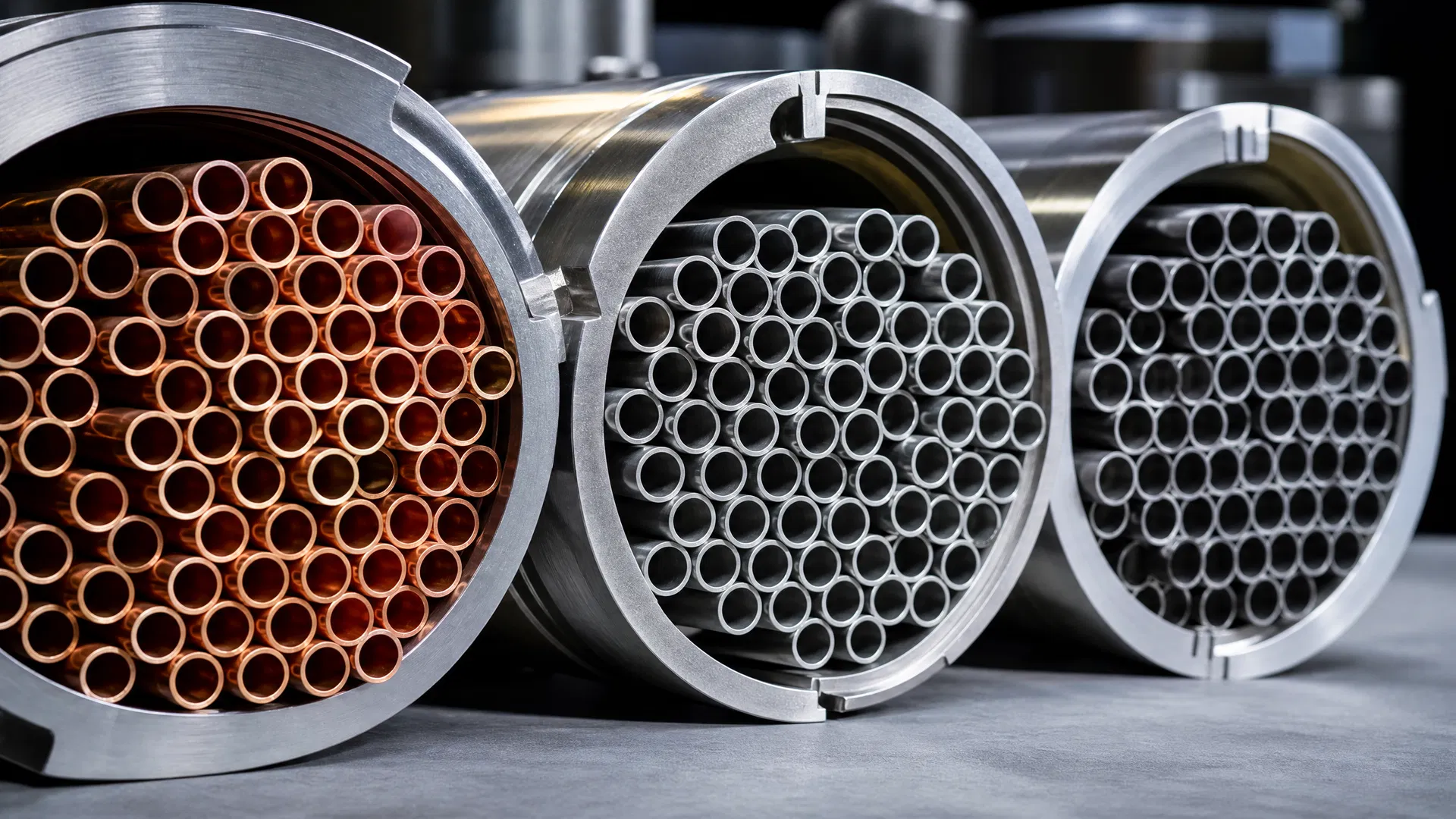
Duplex stainless steel heat exchangers — particularly those made from 2205 (UNS S31803/S32205) and super duplex 2507 (UNS S32750) — are among the most valuable standard-alloy units in the secondary market. These grades combine the strength of ferritic stainless with the corrosion resistance of austenitic stainless, making them highly sought after for chloride-containing services, seawater cooling, and chemical processing. At Surplus Heat Exchangers, we buy duplex and super duplex units nationwide and pay based on verified alloy content — significantly more than generic stainless scrap rates.
Surplus Heat Exchangers buys used and surplus heat exchangers nationwide — 100% upfront, with free rigging and freight, in any condition. Send a photo of the nameplate to 951-403-5738 for a same-day cash offer.
Why Duplex Commands Premium Pricing
Duplex stainless steels occupy a unique position in the materials hierarchy — more expensive than standard austenitic grades (304, 316) but less costly than exotic nickel alloys (Hastelloy, Inconel). This middle ground makes them extremely popular for demanding services where 316 is inadequate but Hastelloy is overkill. The result is strong, consistent demand in the secondary market.
New duplex stainless steel costs approximately $4–$8 per pound for raw material (compared to $2–$4 for 316 SS and $25–$45 for Hastelloy C-276). A new duplex heat exchanger costs 40–80% more than an equivalent 316 SS unit. This price premium carries directly into the secondary market — used duplex exchangers command proportionally higher resale prices than standard stainless units.
The secondary market demand for duplex is driven by several factors: long lead times for new duplex fabrication (specialized welding procedures and heat treatment requirements add 4–8 weeks to delivery), limited availability of qualified duplex fabricators, and the growing adoption of duplex in industries that previously used carbon steel or standard stainless (particularly offshore oil and gas, desalination, and chemical processing).
Identifying Duplex Stainless Steel in Your Equipment
Duplex stainless steel is not always obvious to identify visually — it looks similar to standard austenitic stainless steel. Here are the reliable identification methods:
Nameplate designations: Look for these material callouts on the manufacturer's nameplate or data report:
- UNS S31803 or S32205 — standard duplex 2205
- UNS S32750 or S32760 — super duplex 2507/Zeron 100
- UNS S32101 — lean duplex 2101
- UNS S32304 — lean duplex 2304
- UNS S32550 — alloy 255 (ferralium)
- ASTM A789, A790, A815 — duplex pipe and fitting specifications
- ASTM A240 Type S31803/S32205 — duplex plate specification
Magnetic test: Duplex stainless steels are moderately magnetic due to their ferritic phase content (approximately 50% ferrite). Standard austenitic grades (304, 316) are non-magnetic or very weakly magnetic. If your stainless steel heat exchanger responds noticeably to a magnet but is clearly not carbon steel (no rust, bright finish), it may be duplex. This is not definitive — some cold-worked austenitic steels also become slightly magnetic — but it is a useful screening test.
XRF analysis: The definitive identification method. Duplex 2205 has a distinctive composition: approximately 22% chromium, 5% nickel, 3% molybdenum, and 0.15% nitrogen. Standard 316 SS has 16-18% chromium, 10-14% nickel, and 2-3% molybdenum. The lower nickel and higher chromium content of duplex is immediately apparent on an XRF reading.
Service history clues: Duplex is commonly specified for seawater cooling, chloride-containing process streams, offshore platforms, desalination plants, pulp mill bleach plants, and chemical processes involving chlorides at elevated temperatures. If your exchanger served in any of these applications, there is a reasonable probability it is duplex.
Duplex Grade Comparison and Value
| Grade | UNS designation | Key composition | Typical scrap value (per lb) | Pitting resistance (PREN) | Common applications |
|---|---|---|---|---|---|
| Lean duplex 2304 | S32304 | 23Cr-4Ni-0.1Mo | $0.80–$1.50 | ~25 | Storage tanks, structural, low-chloride |
| Lean duplex 2101 | S32101 | 21Cr-1.5Ni-0.3Mo-5Mn | $0.60–$1.20 | ~26 | Structural, transport tanks |
| Standard duplex 2205 | S31803/S32205 | 22Cr-5Ni-3Mo-0.15N | $1.20–$2.50 | ~35 | Chemical process, seawater, offshore |
| Super duplex 2507 | S32750 | 25Cr-7Ni-4Mo-0.27N | $1.80–$3.50 | ~42 | Aggressive chlorides, hot seawater, FGD |
| Super duplex Zeron 100 | S32760 | 25Cr-7Ni-3.5Mo-0.7Cu-0.25N | $1.80–$3.50 | ~41 | Subsea, aggressive offshore |
| Hyper duplex | S32707/S33207 | 27Cr-7Ni-5Mo-0.4N | $2.50–$4.50 | ~49 | Extreme chloride, hot concentrated acids |
Note: PREN (Pitting Resistance Equivalent Number) = %Cr + 3.3×%Mo + 16×%N. Higher PREN indicates better resistance to pitting and crevice corrosion in chloride environments.
Why We Pay More Than Scrap Yards for Duplex
The same problem that affects exotic alloy exchangers at scrap yards applies to duplex, often even more severely:
Misidentification as 304 or 316: Without XRF testing, duplex looks identical to standard austenitic stainless steel. Many scrap yards classify it simply as "stainless" and pay 304/316 rates — which can be 30–60% below the actual duplex value. The magnetic response of duplex sometimes causes it to be classified as "400-series" stainless (ferritic), which pays even less.
No reuse assessment: A duplex heat exchanger in good condition has resale value of 3–5× its scrap alloy value because it saves the end user the cost and lead time of new fabrication. Scrap yards cannot capture this premium — they melt everything regardless of condition.
Mixing penalties: If a duplex exchanger with a carbon steel shell is delivered as a complete unit, the scrap yard may price the entire assembly at carbon steel rates rather than separating and valuing the duplex components individually.
When you sell to Surplus Heat Exchangers, we verify the grade by XRF, assess reuse potential, and value each component at its proper alloy rate. This consistently yields 2–4× more than scrap yard pricing for duplex equipment.
Industries That Generate Surplus Duplex Exchangers
If your facility operates in any of these sectors, you likely have duplex stainless steel heat exchangers that we want to buy:
- Offshore oil and gas: Platform decommissioning generates large quantities of duplex and super duplex exchangers from seawater cooling systems, produced water handling, and process cooling.
- Desalination: Reverse osmosis and thermal desalination plants use duplex extensively for brine handling and heat recovery.
- Chemical processing: Chlor-alkali plants, organic chemical synthesis, and any process involving chloride-containing streams at elevated temperatures.
- Pulp and paper: Bleach plant exchangers, chlorine dioxide systems, and effluent cooling.
- Marine and shipbuilding: Seawater cooling systems on vessels and offshore structures.
- Flue gas desulfurization: FGD systems in power plants use duplex and super duplex for resistance to hot, acidic, chloride-containing scrubber solutions.
- Geothermal energy: Geothermal brine handling systems use duplex for resistance to hot, saline, CO2-containing fluids.
Sell Your Duplex Heat Exchanger to Us
Whether you have a single duplex exchanger from a process change or dozens of units from a platform decommissioning, Surplus Heat Exchangers pays premium prices for duplex and super duplex equipment. We buy 2205, 2507, Zeron 100, and all other duplex grades in any condition — working, idle, damaged, or decommissioned.
Do not send duplex stainless steel to a scrap yard that will misidentify it and pay standard stainless rates. The difference between proper duplex valuation and generic stainless pricing can be thousands or tens of thousands of dollars per unit.
Call us at 951-403-5738 or use our secure online quote form with your nameplate data, XRF results, or service history. We provide free alloy verification and cash offers within 24 hours. Get your premium offer today.