
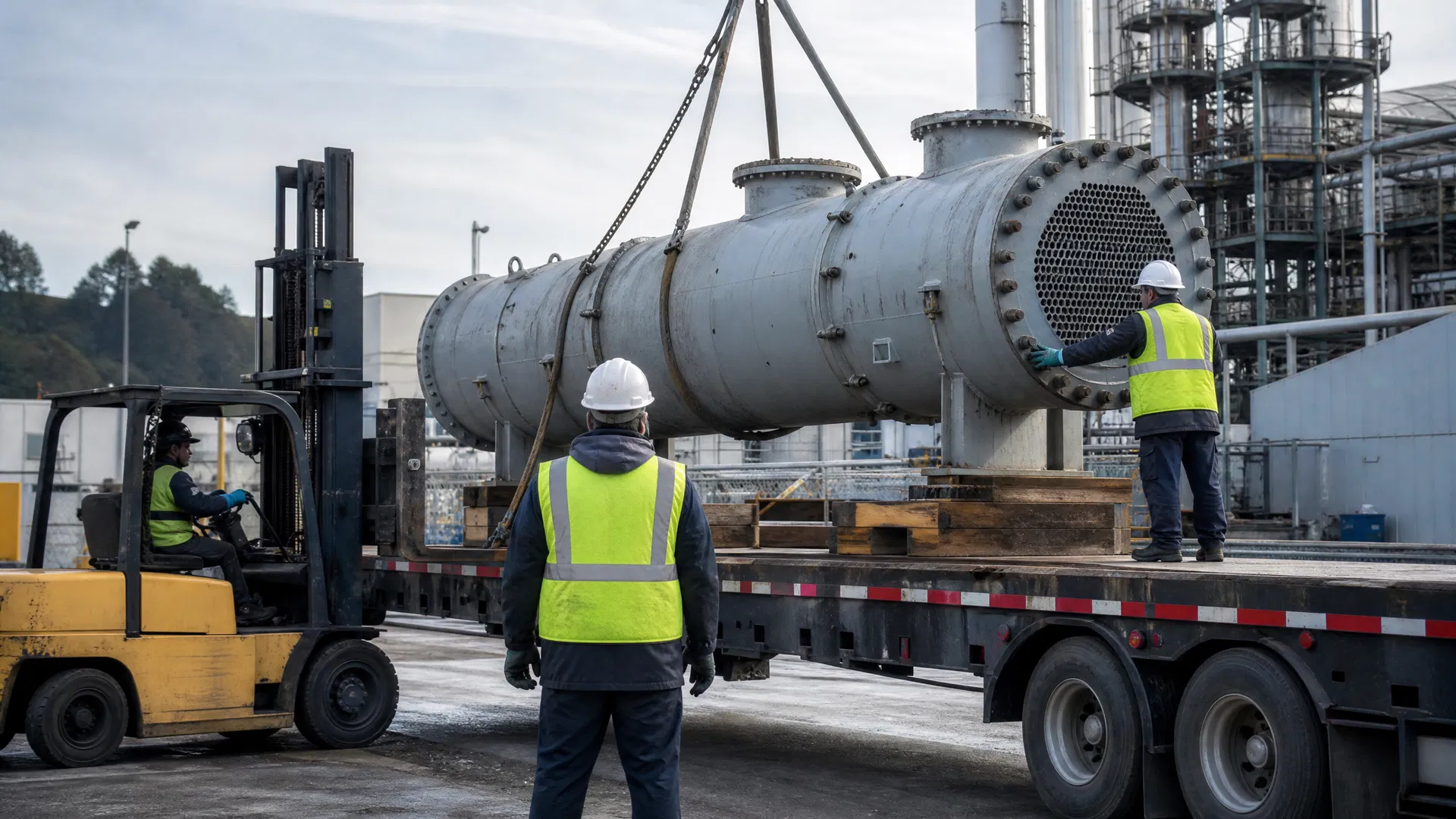
If your heat exchanger was damaged by fire, flood, impact, process upset, or any other insured event, the equipment still has significant value after the insurance claim is settled — and we want to buy it. Surplus Heat Exchangers purchases post-claim and damaged heat exchangers nationwide, often recovering 20–60% of original equipment value from units that insurance adjusters wrote off as total losses. The insurance settlement covers your replacement cost; selling the damaged unit to us puts additional cash in your pocket on top of the claim.
Surplus Heat Exchangers buys used and surplus heat exchangers nationwide — 100% upfront, with free rigging and freight, in any condition. Send a photo of the nameplate to 951-403-5738 for a same-day cash offer.
Why Damaged Heat Exchangers Still Have Value
Insurance adjusters evaluate heat exchangers based on replacement cost versus repair cost. If repair exceeds a threshold (typically 60–70% of replacement value), they declare a total loss and pay the replacement amount. But "total loss" from an insurance perspective does not mean "zero value" from an equipment perspective.
A heat exchanger that is a total loss for insurance purposes — meaning it is not economically repairable to its original specification — may still have substantial value for:
- Remanufacturing: The undamaged components (shell, tubesheets, channel covers, flanges) can be reused in a rebuilt unit at a fraction of new cost.
- Parts recovery: Individual components have standalone value. A damaged shell-and-tube exchanger may have a perfectly good tube bundle worth $15,000–$50,000+.
- Alloy recovery: The material value of exotic alloys (stainless steel, titanium, Hastelloy, Inconel, copper alloys) is unaffected by physical damage. A fire-damaged titanium exchanger has the same alloy value as an undamaged one.
- Lower-rating service: A unit damaged in a way that reduces its pressure rating may still be perfectly usable at a lower rating for a different application.
Common Damage Scenarios and Recovery Value
| Damage type | What typically survives | Typical recovery (% of original value) | Primary value stream |
|---|---|---|---|
| Fire/heat damage | Shell integrity (if not prolonged); alloy content | 15–40% | Alloy recovery; component reuse if not heat-affected |
| Flood/submersion | All structural components (corrosion is surface-only) | 30–60% | Refurbishment and resale after cleaning/inspection |
| Impact/drop damage | Undamaged end (one head/channel); tube bundle; alloy | 20–50% | Parts recovery; remanufacturing with new shell section |
| Process upset (overpressure) | Tubes, tubesheets, flanges (if shell bulged but not ruptured) | 25–45% | Component reuse; tube bundle resale |
| Corrosion breakthrough | Shell (if localized); tube bundle; all non-corroded components | 20–40% | Repair and rerate; parts recovery |
| Freeze damage | Shell (usually); tubesheets; channel covers | 25–50% | Retube and resell; component recovery |
| Transportation damage | Depends on impact location; often most of the unit | 30–60% | Repair if localized; parts if extensive |
The Insurance Claim Process and Equipment Disposition
Understanding how insurance claims work helps you maximize total recovery (claim + equipment sale):
Step 1: File the claim. Report the damage to your insurer and document everything — photos, incident reports, inspection findings. The more documentation you provide, the smoother the claim process.
Step 2: Adjuster evaluation. The insurance adjuster (or their engineering consultant) evaluates repair cost versus replacement cost. They will determine whether the unit is a total loss or repairable.
Step 3: Settlement. If declared a total loss, you receive the replacement value (minus deductible and depreciation, depending on your policy). If repairable, you receive the repair cost. Either way, you typically retain ownership of the damaged equipment unless the policy specifies salvage rights to the insurer.
Step 4: Sell the damaged equipment to us. After the claim is settled and you retain the equipment, contact Surplus Heat Exchangers for a cash offer on the damaged unit. This is additional money on top of your insurance settlement.
Important note on salvage: Some insurance policies include salvage clauses where the insurer takes ownership of damaged equipment after paying a total loss claim. Review your policy or ask your adjuster whether you retain salvage rights. If the insurer claims salvage, they may be willing to sell it to you at a nominal price (since they do not want to deal with heavy industrial equipment), allowing you to then sell it to us at market value.
Maximizing Total Recovery: Claim + Sale
The key insight is that insurance settlements and equipment sales are separate value streams that stack:
- Insurance pays: Replacement cost (or repair cost) minus deductible and depreciation
- Equipment sale pays: Residual value of damaged unit based on alloy content, reusable components, and remanufacturing potential
- Total recovery: Often exceeds 100% of the original equipment book value when both streams are captured
Many facility owners leave the second stream on the table — they collect the insurance check and then send the damaged equipment to a scrap yard for minimal return, or worse, pay to have it hauled away as waste. By selling to us instead, you capture the full residual value of the equipment.
What We Need From You
To provide a cash offer on your damaged heat exchanger, we need:
- Photos of the damage: Overall views plus close-ups of the damaged area(s). This helps us assess what is salvageable.
- Nameplate data: Manufacturer, serial number, design pressure/temperature, materials of construction. If the nameplate is damaged or illegible, any documentation you have (U-1 form, purchase records, maintenance files) helps.
- Damage description: What happened, what is damaged, and what appears undamaged. Be honest — we will inspect the unit anyway, and accurate descriptions lead to accurate offers that do not change after inspection.
- Insurance status: Has the claim been settled? Do you retain salvage rights? Is there a timeline for equipment removal?
Fire-Damaged Heat Exchangers: Special Considerations
Fire is the most common cause of insured heat exchanger damage. Key considerations for fire-damaged units:
Heat-affected zone assessment: Prolonged exposure to temperatures above the material's design limit can alter metallurgical properties (sensitization in stainless steel, temper embrittlement in carbon steel, grain growth). However, brief fire exposure (minutes to an hour) often does not penetrate thick vessel walls enough to affect structural integrity. We evaluate this with hardness testing and metallurgical examination.
Alloy value is unaffected: Fire does not change the chemical composition of metals. A fire-damaged Hastelloy exchanger has the same alloy recovery value as an undamaged one. For exotic alloy units, fire damage may reduce reuse value but has zero impact on material value.
Insulation and external components: Fire typically destroys insulation, paint, gaskets, and instrumentation — all of which are consumable items that do not affect the vessel's core value. A fire-damaged exchanger that lost its insulation and paint but retained shell integrity is still highly valuable.
Sell Your Damaged Heat Exchanger to Us
Do not pay to dispose of equipment that has real value. Whether your heat exchanger was damaged by fire, flood, impact, freeze, or process upset, Surplus Heat Exchangers will buy it for cash based on its residual value — alloy content, reusable components, and remanufacturing potential.
Call us at 951-403-5738 or use our secure online quote form with photos and nameplate data. We provide damage-assessment offers within 24–48 hours. The insurance claim covers your replacement; selling the damaged unit to us puts additional cash in your pocket. Get your cash offer today.