

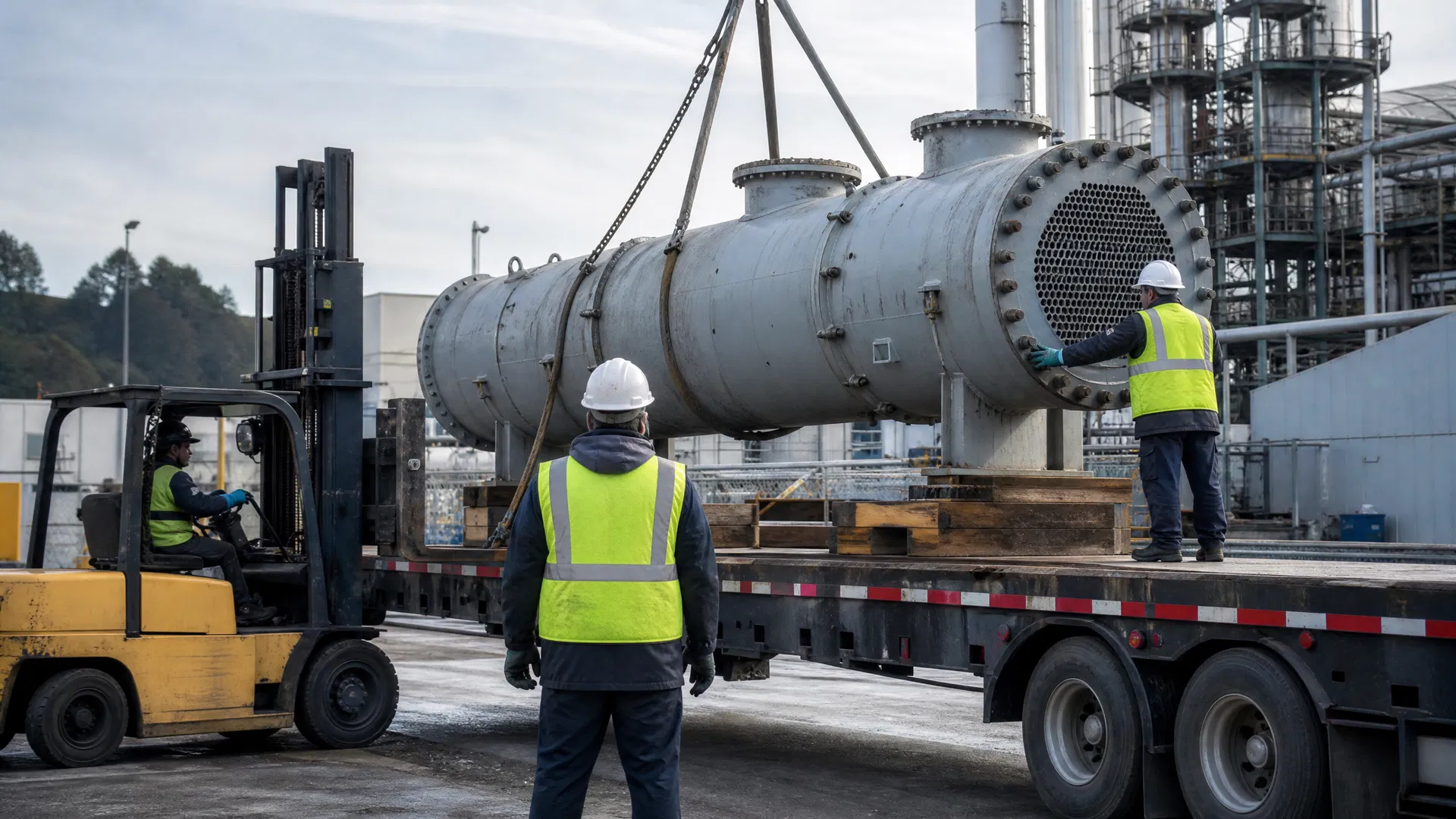
Freight and rigging costs can severely diminish the net profit from selling a used heat exchanger, often consuming thousands of dollars in crane rentals, specialized trailers, and oversize load permits. When you sell to a buyer who covers 100% of the removal and transportation expenses, you eliminate these logistical financial burdens and secure a higher, guaranteed net payout. Partnering with a buyer that handles all freight ensures you keep the full value of your equipment without out-of-pocket risks.
Surplus Heat Exchangers buys used and surplus heat exchangers nationwide — 100% upfront, with free rigging and freight, in any condition. Send a photo of the nameplate to 951-403-5738 for a same-day cash offer.
How do freight and rigging costs impact the final payout for your used heat exchanger?
When industrial facilities, mechanical contractors, or plant managers decide to sell surplus or decommissioned heat exchangers, they often focus solely on the equipment's gross value. However, the true net return is heavily dictated by the logistics required to move these massive units. Freight and rigging costs are not minor line items; they are substantial expenses that can rapidly erode your profits. A standard shell and tube heat exchanger or a large plate and frame unit from brands like Alfa Laval, GEA, or Tranter can weigh anywhere from a few thousand pounds to over 100,000 pounds. Moving such heavy machinery requires specialized rigging crews, heavy-duty cranes, and specialized freight carriers. If you are responsible for these costs, a unit that seems valuable on paper might yield a surprisingly low net return once the transportation invoices are paid. This is why understanding the hidden costs of logistics is critical before agreeing to a sale.
Why are rigging and removal costs so high for industrial heat exchangers?
Rigging an industrial heat exchanger out of a process plant or mechanical room is a complex engineering task. These units are often installed in tight spaces, elevated platforms, or deep within a facility's infrastructure. Removing a large TEMA-designated shell and tube heat exchanger (such as TEMA Type BEM, AEL, or NEN) requires meticulous planning. You cannot simply load it onto a truck with a standard forklift. Professional rigging companies must be hired to safely disconnect, lift, and maneuver the equipment. This often involves renting gantry cranes, high-capacity forklifts, or even mobile hydraulic cranes, which can cost anywhere from a meaningful amount to over a meaningful amount per day depending on the tonnage required. Additionally, rigging crews charge specialized labor rates due to the high-risk nature of the work and the insurance liabilities involved. If the heat exchanger is located on a roof or requires partial demolition of walls for extraction, the rigging costs multiply exponentially. When a seller has to absorb these costs, the financial viability of selling the equipment diminishes rapidly.
How much does it cost to ship an oversize shell and tube heat exchanger?
Transportation is the second major logistical hurdle. Standard freight rates do not apply to large industrial heat exchangers. Depending on the dimensions and weight, shipping a surplus heat exchanger often requires specialized trailers such as step-decks, double drops, or Removable Gooseneck (RGN) trailers. If the unit exceeds standard legal dimensions (typically over 8.5 feet wide, 13.5 feet tall, or 80,000 pounds gross vehicle weight), it is classified as an oversize or overweight load.
Shipping an oversize load introduces a cascade of additional expenses:
- Specialized Trailers: RGN and multi-axle trailers command premium rates, often exceedinga strong resale figure per mile.
- Permits: Oversize load permits must be purchased for every individual state the truck travels through, adding hundreds or thousands of dollars to the route.
- Escort Vehicles: Extremely wide or heavy units may require pilot cars (escort vehicles) in the front and rear, and sometimes even police escorts, doubling or tripling the per-mile cost.
- Route Surveys: For massive TEMA heat exchangers, logistics companies must conduct route surveys to ensure bridges can handle the weight and overpasses have sufficient clearance.
For a cross-country shipment, freight costs alone can easily range froma strong resale figure or more. If you are selling a unit for its scrap value or even its resale value, these freight costs can consume the majority of your expected payout.
What is the true value of your used heat exchanger when factoring in logistics?
To understand the impact of freight and rigging, you must look at the baseline value of the equipment. Used shell and tube heat exchangers typically resell for roughly a significant premium over scrap based on its heat-transfer surface area, depending heavily on the materials of construction, condition, and current market demand. Alternatively, if the unit is at the end of its lifecycle, its value is tied to the scrap metal market.
Current estimated scrap values for common heat exchanger materials are:
- Carbon Steel: only a baseline commodity rate
- 304 Stainless Steel: only a baseline commodity rate
- 316 Stainless Steel: only a baseline commodity rate
- Admiralty Brass: only a baseline commodity rate
- Cupro-Nickel: only a baseline commodity rate
- Copper: only a baseline commodity rate
- Titanium: only a baseline commodity rate
Let's compare the net payout scenarios when you pay for logistics versus when the buyer pays.
As the table illustrates, absorbing the cost of rigging and freight drastically reduces your actual profit. When you factor in the time and effort required to coordinate these services, the net return becomes even less attractive.
How do different materials and TEMA types affect transportation logistics?
The construction material and specific TEMA design of your heat exchanger play a significant role in both its value and its transportation logistics. High-alloy units made of Titanium, Hastelloy, or Inconel are incredibly valuable, but they are also highly specialized. A titanium shell and tube heat exchanger might have a scrap value of only a baseline commodity rate, making it highly lucrative. However, these units are often utilized in severe chemical processing environments and can be exceptionally heavy due to thick tubesheets and heavy-duty flanges.
Similarly, large plate and frame heat exchangers from manufacturers like SWEP, Kelvion, or SPX/APV can be deceptively heavy. While they have a compact footprint compared to shell and tube designs, the dense stack of stainless steel or titanium plates, combined with massive carbon steel end frames, means a relatively small unit can weigh 20,000 pounds. This density requires heavy-duty rigging equipment even if the physical dimensions do not trigger oversize load permits. Standard Xchange and ITT shell and tube units used in power generation or petrochemical refining often feature massive U-tube bundles (TEMA Type BEU) that require careful handling to prevent damage to the baffles and tubes during transit. A buyer who understands these nuances will coordinate the appropriate specialized transport, ensuring the unit is moved safely without burdening the seller with the logistical headache.
Why should you sell to a buyer who covers 100% of freight and rigging?
Navigating the complexities of heavy machinery logistics is not the core business of most plant managers or mechanical contractors. Your goal is to clear out surplus equipment, recover capital, and focus on your primary operations. When you attempt to manage the sale, rigging, and freight yourself, you take on significant financial and operational risks. What if the crane rental goes over schedule? What if the freight carrier encounters permit delays? These variables eat into your expected return.
By selling to a specialized buyer like Surplus Heat Exchangers, you transfer all of this risk. We are a nationwide buyer that purchases used and surplus heat exchangers in any condition. Because we handle industrial logistics every day, we have established networks of professional riggers and heavy-haul freight carriers across the country. We absorb the costs and the logistical headaches, allowing us to offer you a clean, straightforward transaction. You don't have to worry about fluctuating freight rates or crane rental minimums; you simply receive your payment and watch the equipment leave your site.
How can you sell your used heat exchanger with zero out-of-pocket costs?
Selling your surplus heat exchanger should be a profitable and seamless experience, not a logistical nightmare that drains your budget. At Surplus Heat Exchangers, we have streamlined the purchasing process to ensure you get paid quickly with absolutely zero out-of-pocket costs for freight or rigging. We buy all types of heat exchangers, including shell and tube, plate and frame, air-cooled, and spiral units, regardless of their current condition.
Here is how our hassle-free process works:
- Step 1: Gather Information. Take clear photos of the heat exchanger, capturing the overall unit and a close-up of the manufacturer's data plate (nameplate). The nameplate provides crucial details like the brand, materials, pressure ratings, and dimensions.
- Step 2: Contact Us. Send your photos and information to our secure online quote form or call us directly at 951-403-5738.
- Step 3: Receive a Fast Offer. We will evaluate the equipment based on its resale potential or material value (such as the only a baseline commodity rate for 316 stainless or only a baseline commodity rate for cupro-nickel) and provide a competitive cash offer.
- Step 4: Get Paid 100% Upfront. Once you accept the offer, we pay you 100% upfront before the equipment ever leaves your facility.
- Step 5: We Handle the Rest. We coordinate and pay for all rigging, loading, and heavy-haul freight. You simply provide access to the site, and our professionals handle the extraction and transportation.
Don't let exorbitant freight and rigging costs eat away at the value of your surplus equipment. Contact Surplus Heat Exchangers today to turn your idle machinery into upfront cash, with zero logistical stress.