

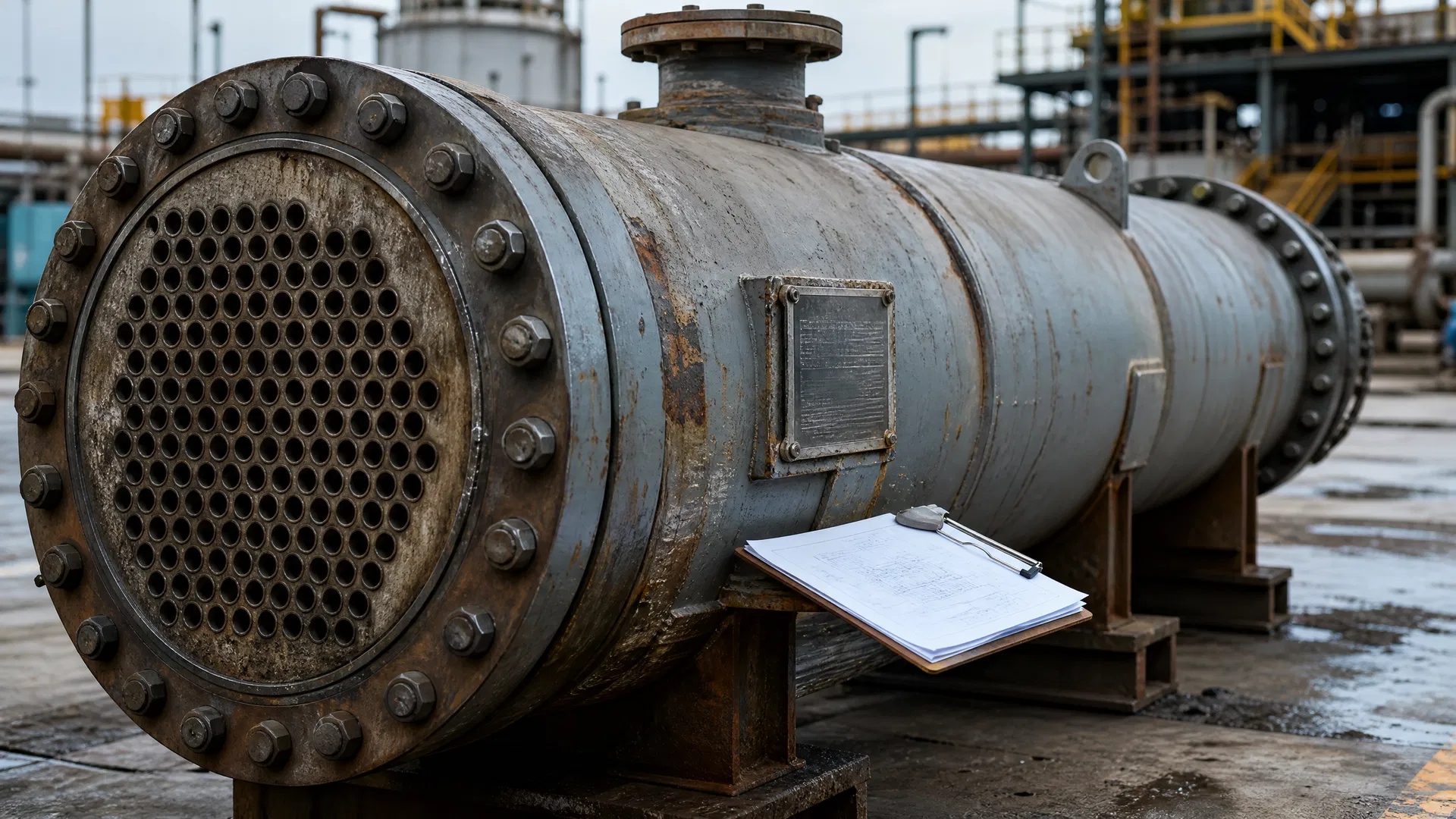
The resale price of a used heat exchanger is heavily driven by its total surface area and physical size, but the relationship is not strictly linear. While larger units generally command higher total prices due to increased material weight and heat transfer capacity, the value often decreases as size increases. Ultimately, the combination of square footage, construction materials, and operational condition determines whether a unit is valued for its functional reuse or its base scrap weight.
Surplus Heat Exchangers buys used and surplus heat exchangers nationwide — 100% upfront, with free rigging and freight, in any condition. Send a photo of the nameplate to 951-403-5738 for a same-day cash offer.
How does the total surface area of a heat exchanger impact its resale value?
When evaluating a used heat exchanger, the total surface area—typically measured in square feet—is one of the most critical metrics for determining its operational resale value. For shell and tube heat exchangers, operational resale values generally range from a significant premium over scrap value, depending heavily on the materials of construction, the condition of the tubes, and the specific TEMA design type.
A larger surface area means the unit can handle more significant thermal loads, making it highly desirable for large-scale industrial applications such as petrochemical refining and power generation. However, when you are looking to sell your surplus equipment, it is important to understand that surface area is just the starting point. A massive 10,000-square-foot carbon steel unit might have a lower total value than a specialized 2,000-square-foot titanium unit. At Surplus Heat Exchangers, we evaluate the exact square footage alongside the material composition to provide the highest possible cash offer.
Why isn't a larger heat exchanger always worth more ?
It is a common misconception that if a 500-square-foot heat exchanger is worth a certain amount, a 5,000-square-foot unit will be worth exactly ten times as much. In reality, the resale market for industrial equipment often follows the principle of economies of scale. As the physical size and surface area of a heat exchanger increase, the resale value typically decreases.
There are several reasons for this pricing dynamic. First, the pool of potential end-users shrinks as the size of the equipment grows. While a small, versatile 200-square-foot stainless steel U-tube exchanger can be easily integrated into hundreds of different food processing plants, a massive 15,000-square-foot TEMA AES unit is usually only suitable for specific, large-scale chemical or refinery operations. Additionally, the logistical costs associated with moving massive equipment can eat into the gross value. Fortunately, when you sell to Surplus Heat Exchangers, we handle all rigging and freight costs completely free of charge, ensuring you get 100% of the agreed-upon value upfront.
How do materials of construction affect the value of large vs. small units?
The materials used to construct the shell, tubes, tubesheets, and baffles play a monumental role in determining the value of a heat exchanger, often overriding the sheer size of the unit. High-performance alloys are expensive to source, meaning that even relatively small units made from premium materials can command exceptional resale prices.
For example, a compact plate and frame heat exchanger manufactured by Alfa Laval or Tranter with titanium plates will often be worth significantly more than a much larger carbon steel shell and tube unit. Current scrap values vary widely based on the metallurgy:
- Carbon steel typically yields only a baseline commodity rate.
- 304 stainless steel ranges from only a baseline commodity rate.
- 316 stainless steel commands only a baseline commodity rate.
- Copper and copper alloys are highly valuable, with pure copper at only a baseline commodity rate, admiralty brass at only a baseline commodity rate, and cupro-nickel at only a baseline commodity rate.
- Titanium is among the most lucrative, often fetching only a baseline commodity rate.
Whether your unit is a small SWEP brazed plate exchanger or a massive Standard Xchange shell and tube, providing clear photos of the nameplate allows us to accurately assess its maximum value.
What is the difference between scrap value and operational resale value based on size?
When you are looking to liquidate surplus industrial equipment, understanding the distinction between scrap value and operational resale value is crucial. Scrap value is based entirely on the raw weight and metallurgical composition of the unit, completely ignoring its functional design, brand, or surface area. Operational resale value factors in the unit's ability to be refurbished and put back into service.
For smaller units, the operational resale value is almost always significantly higher than the scrap value. A 300-square-foot 316 stainless steel heat exchanger might only weigh 1,500 pounds, yielding a scrap value of around a meaningful amount However, its operational value could easily exceed a meaningful amount if it is in excellent condition. For extremely large units made of basic carbon steel that have suffered extensive corrosion, the operational demand might be so low that the unit is valued primarily for its scrap weight.
At Surplus Heat Exchangers, we always aim to pay above scrap value whenever a unit has operational potential.
How do TEMA designations and specific brands influence the pricing of large heat exchangers?
The engineering standards and the original manufacturer of a heat exchanger significantly impact its resale value, particularly for large-scale industrial units. The Tubular Exchanger Manufacturers Association (TEMA) sets rigorous standards for the design of shell and tube heat exchangers. Units built to TEMA Class R (for severe requirements in petroleum processing) are generally built with thicker materials and higher tolerances than TEMA Class C (for general commercial applications). Consequently, a large TEMA R unit will retain its value much better than a similarly sized TEMA C unit.
Brand reputation also plays a vital role. Equipment manufactured by industry leaders such as GEA, ITT, SPX/APV, and Kelvion carries a premium in the secondary market. Buyers trust these brands for their reliability and proven thermal efficiency. If you have a large, branded unit, it still holds substantial value. When you contact us to sell your equipment, mentioning the brand and TEMA designation found on the nameplate helps us expedite a high-value cash offer.
Does the physical weight of a heat exchanger guarantee a higher cash offer?
While physical weight is a guaranteed baseline for value due to the inherent scrap metal content, it does not automatically guarantee a higher overall cash offer compared to a lighter, more specialized unit. Weight is primarily a function of the materials used and the operating pressures the unit was designed to withstand. A high-pressure heat exchanger requires incredibly thick tube sheets and shell walls, drastically increasing its weight without increasing its heat transfer surface area.
If a heavy unit is constructed entirely of carbon steel, its massive weight might only yield only a baseline commodity rate on the scrap market. Conversely, a much lighter plate and frame heat exchanger made with thin corrugated titanium plates will weigh a fraction of the carbon steel unit but could be worth exponentially more due to the high value of titanium (only a baseline commodity rate) and its specialized operational capabilities. Therefore, weight must always be contextualized by the material type and the functional design of the heat exchanger.
How does the condition of the tube bundle and shell affect the valuation of large units?
The physical condition of the internal components, specifically the tube bundle and the interior of the shell, is the ultimate deciding factor between a unit being valued for operational reuse or being relegated to scrap. Replacing a damaged tube bundle can cost tens of thousands of dollars, which severely depresses the resale value of the existing unit.
Key condition factors include:
- Tube Pitting and Corrosion: Extensive pitting or scaling on the tubes reduces heat transfer efficiency and indicates impending failure.
- Plugged Tubes: If a significant percentage of the tubes have been plugged during previous maintenance cycles, the effective surface area is reduced, lowering the unit's value.
- Shell Integrity: Thinning of the shell walls due to erosion or corrosion can render a high-pressure unit unsafe for future use.
Even if your large heat exchanger has significant wear, plugged tubes, or shell damage, Surplus Heat Exchangers will still buy it. We purchase equipment in any condition, from pristine surplus to heavily degraded units destined for material recovery.
How can you sell your used heat exchanger for the best price regardless of its size?
Whether you are looking to offload a massive 20,000-square-foot shell and tube unit from a decommissioned refinery or a handful of small stainless steel plate exchangers from a brewery upgrade, the key to maximizing your return is working with a specialized buyer. General scrap yards will only ever offer you the lowest possible base metal value, ignoring the engineering and operational worth of your equipment.
Surplus Heat Exchangers is a nationwide buyer dedicated exclusively to this type of equipment. We pay 100% upfront before the equipment ever leaves your facility, and we handle all the complex logistics, including specialized rigging and heavy-haul freight, at absolutely no cost to you.
To get started, simply take a few clear photos of the heat exchanger, making sure to get a close-up of the manufacturer's nameplate. Call us today at 951-403-5738 or email your photos to our secure online quote form. We will quickly evaluate the size, surface area, and materials to provide you with a top-dollar cash offer.
| Material | Typical scrap range | Why it matters for resale |
|---|---|---|
| Carbon steel | $0.05–$0.12 / lb | the most common shell/tube material; lowest scrap value but highest resale demand for standard process duty |
| 304 stainless steel | $0.40–$0.70 / lb | corrosion resistant, widely reused in food, dairy and chemical service |
| 316 / 316L stainless steel | $0.55–$0.90 / lb | molybdenum-bearing grade for chloride and marine service; strong resale value |
| Copper | $2.50–$3.50 / lb | found in tube bundles and HVAC coils; high recovery value |
| Admiralty brass | $1.40–$2.20 / lb | classic condenser tube alloy; valued for both scrap and reuse |
| Cupro-nickel (90/10 & 70/30) | $2.00–$3.20 / lb | seawater and brackish-water service; premium resale and scrap |
| Titanium | $3.50–$6.00 / lb | used in aggressive chloride, seawater and chemical duty; the highest-value exchanger material |
Scrap ranges are indicative only and move with commodity markets; reusable units almost always beat scrap. Call 951-403-5738 for a current cash offer.
Key takeaway: across every common alloy, a working heat exchanger is worth far more resold than scrapped — often several times its melt value — so get a resale offer before you weigh it in.